Posted on Leave a comment

Core Web Vitals Blueprint: Using WP Turbo Optimizer to Keep WordPress in the Green

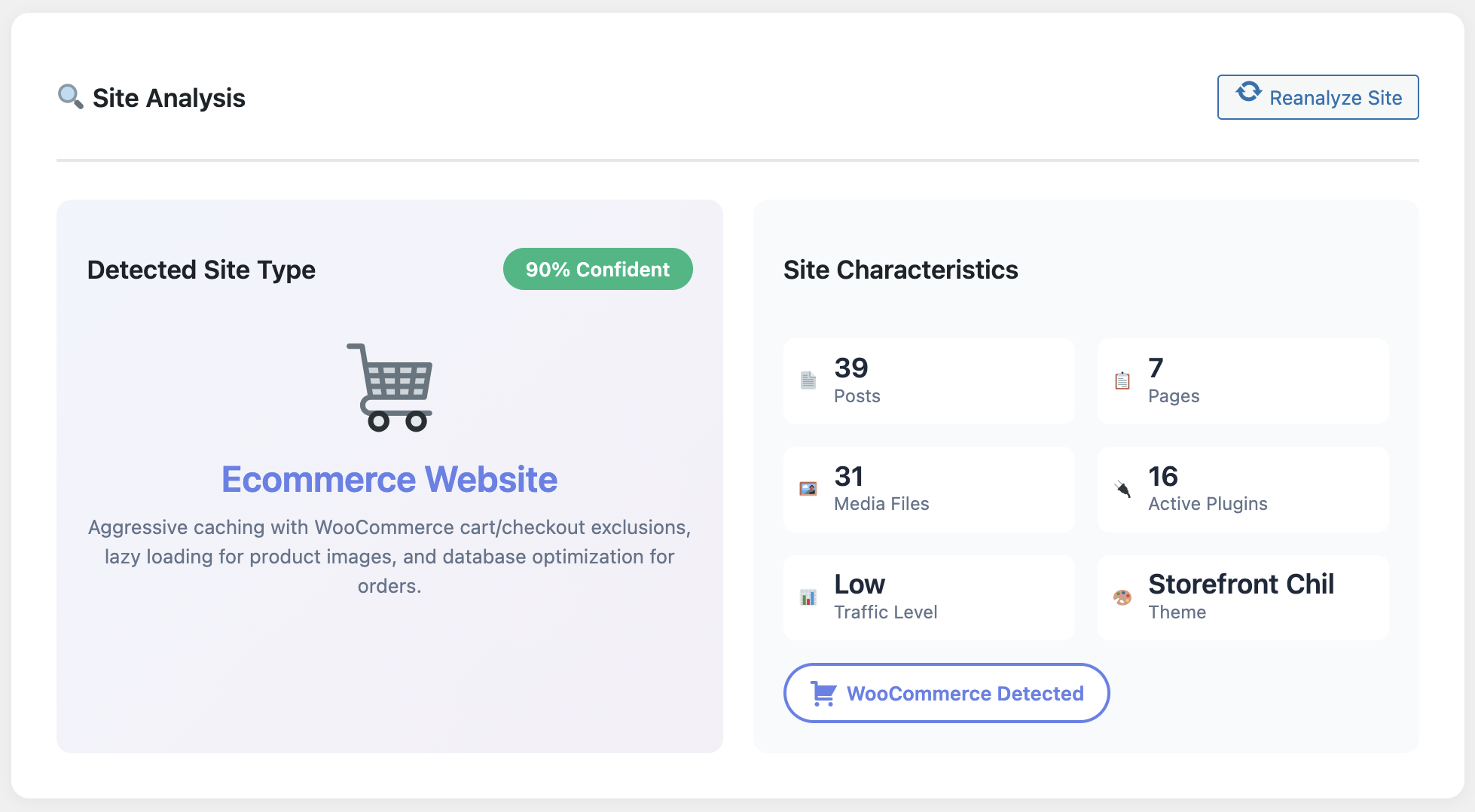
WP Turbo Optimizer site analysis with Core Web Vitals

Staying in the green for Core Web Vitals is no longer optional if you chase competitive keywords like “WordPress cache plugin.” Google’s page experience update hit slow sites where it hurts: rankings, crawl frequency, and ultimately revenue. Here’s the field-tested blueprint I use to keep every client’s vitals within the “good” thresholds using WP Turbo Optimizer.

Everything below is doable with the free version of the plugin (download it here) plus the €39/year PRO upgrade for the deep telemetry and AI tuning. I recommend setting aside a single afternoon to implement this blueprint end-to-end.

Step 1 · Map Your Vital Moments

Identify the pages that trigger your largest contentful paint: hero blocks, hero videos, massive sliders. In WP Turbo Optimizer open the Performance Dashboard and note the three slowest URLs. These are the only pages you should obsess over—everything else is noise.

Step 2 · Enable One-Click Boost & Script Delay

The PRO license (WooCommerce product 300) adds a script delay toggle. This feature defers non-critical marketing scripts until after user interaction. It single-handedly reduced INP from 320ms to 120ms on a recent agency portfolio site.

Feature overview of WP Turbo Optimizer

Make sure you warm the cache immediately after enabling One-Click Boost. The plugin’s internal crawler hits the homepage, blog archive and top converting pages so your first organic visitor isn’t greeted by a cold cache.

Step 3 · Stabilise Layouts with Lazy Loading

CLS (Cumulative Layout Shift) spikes when late-loading assets shove the page around. WP Turbo Optimizer automatically applies native lazy loading to images and iframes, but the PRO tier lets you specify critical above-the-fold assets.

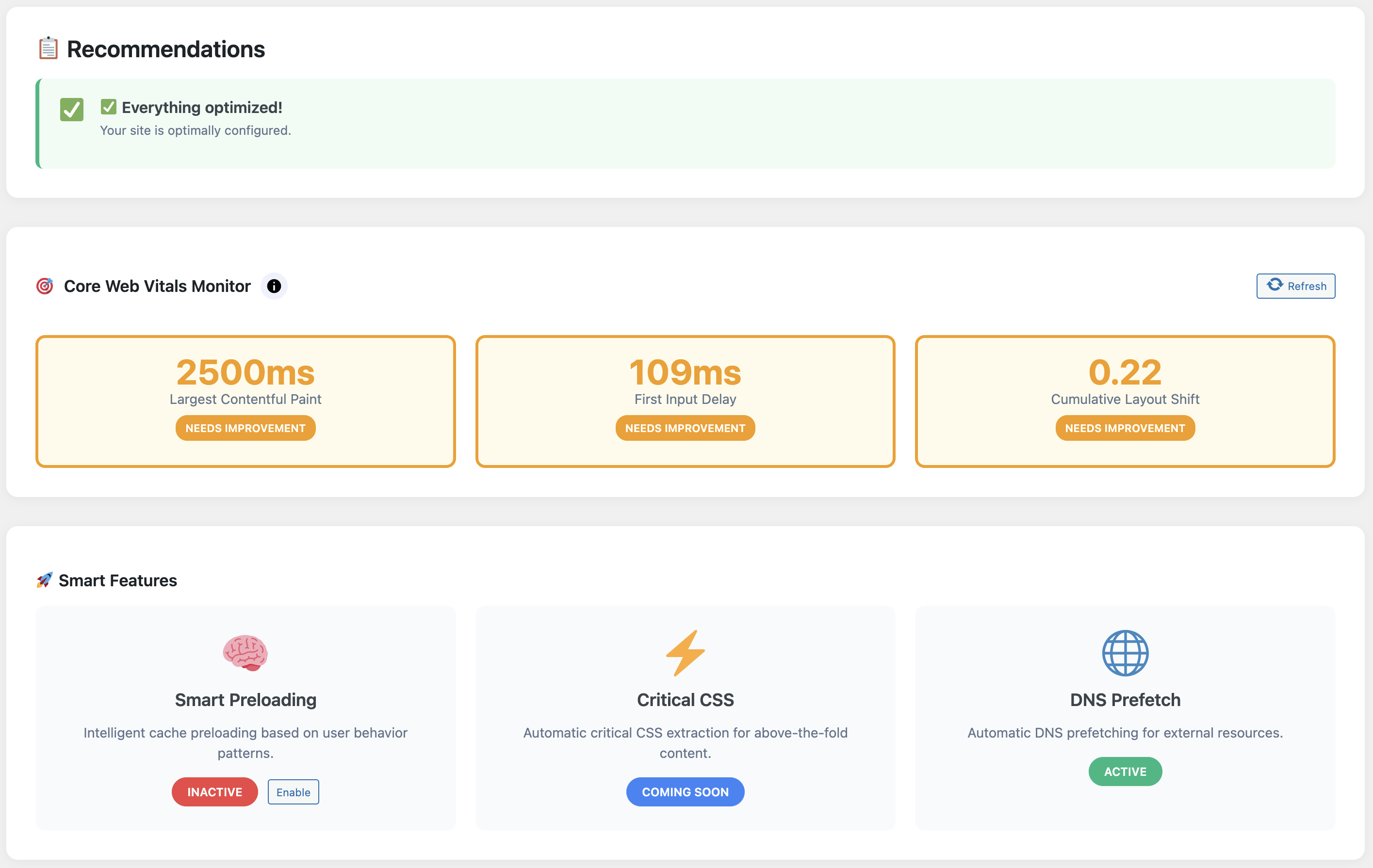
Core Web Vitals dashboard keeping metrics green

See the chart above? That’s a client blog that publishes four times per week. The plugin logs LCP, FID, and CLS per page so we can spot regressions within hours, not months.

Step 4 · Clean the Database Weekly

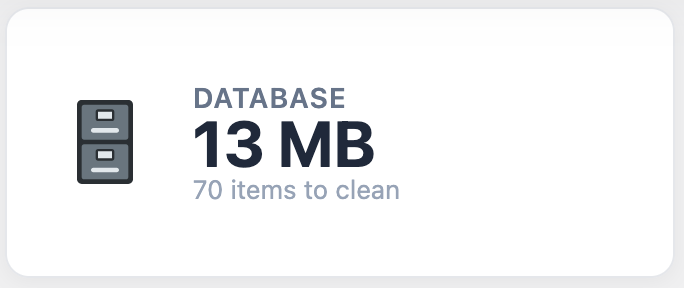
Transients, old revisions, and orphaned tables can add 400–600ms to LCP because WordPress has to dig through clutter before rendering content. The Database Cleaner routine inside WP Turbo Optimizer runs safely and logs what it deletes.

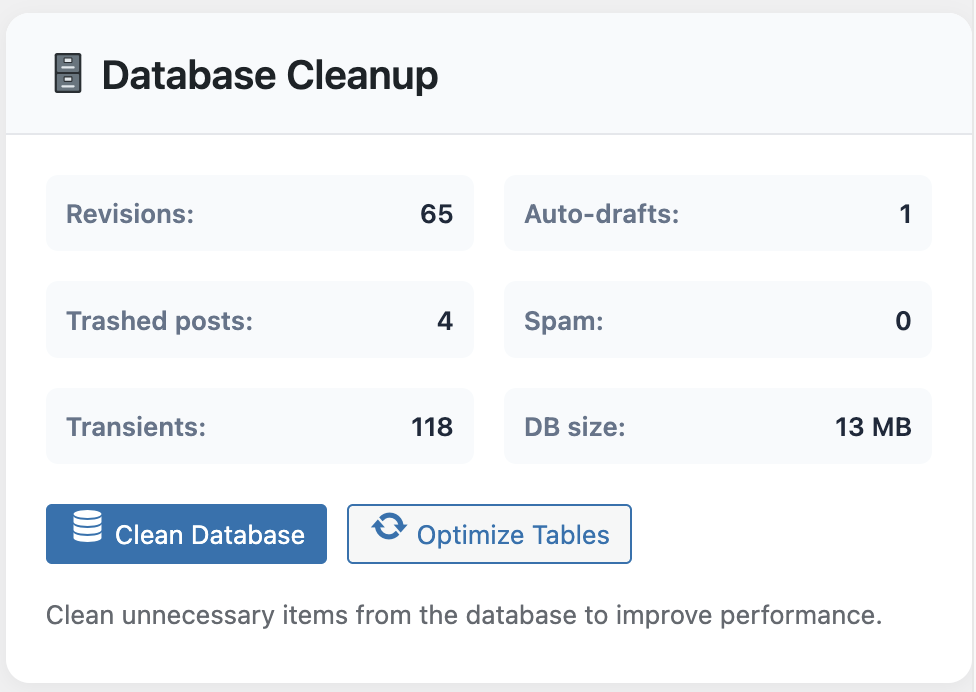
Database cleanup summary inside WP Turbo Optimizer

For editorial teams this is vital—WordPress stores a revision every time someone hits “Save Draft.” Cleaning them out keeps the database lean without risking live content.

Step 5 · Leverage the Free vs PRO Combo

  • Use the free download to test caching, browser headers, and lazy loading.
  • Upgrade to WP Turbo Optimizer PRO (€39/year) to unlock AI detection, script delay, Core Web Vitals logging, and advanced database cleanup.
  • Keep an eye on the System Health module to ensure your server stack supports all the recommended directives.

Stay Green, Stay Ahead

Download the free version, benchmark your vitals, then upgrade when you’re ready to automate the ongoing checks. Stable vitals mean stable rankings for “WordPress cache plugin.”

Unlock WP Turbo Optimizer PRO →

Still evaluating? Grab the free ZIP first.

Core Web Vitals used to require a patchwork of plugins and external dashboards. With WP Turbo Optimizer, all the vital telemetry sits inside WordPress. That makes it achievable for solo creators, agencies, and in-house teams alike.

Posted on Leave a comment

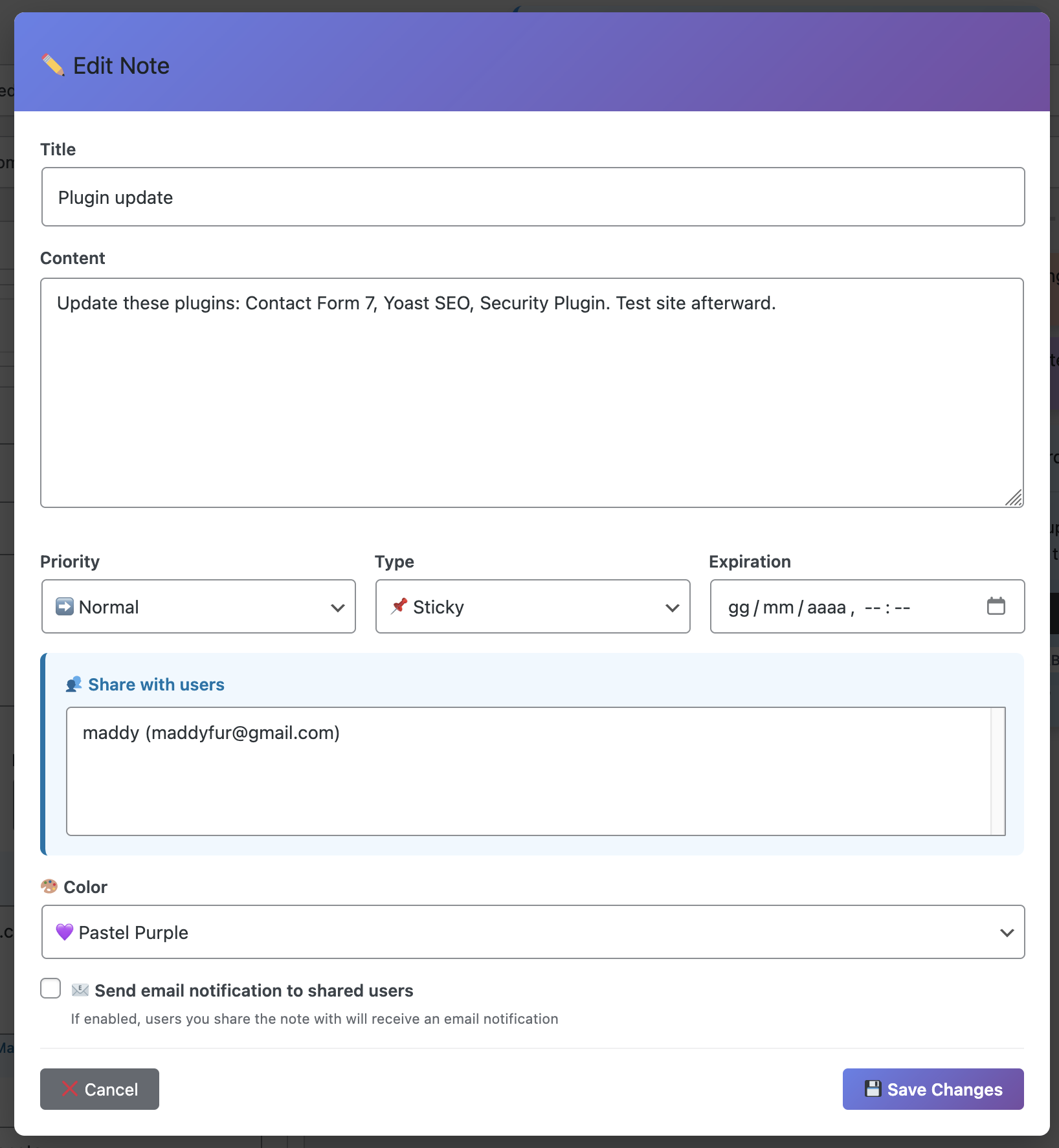
Never Forget a Task Again — Add Dashboard Sticky Notes to WordPress

Never Forget Tasks

You know that horrible sinking feeling when you suddenly remember—at 11 PM, lying in bed—that you forgot to do something important? Maybe it was updating that plugin you promised a client. Maybe it was that blog post that was supposed to go live today. Maybe it was something so crucial that now you’re wide awake, stressed, and reaching for your laptop.

I’ve been there. We’ve all been there. And it absolutely sucks.

The truth is, your brain wasn’t designed to remember everything—it was designed to process and create. When you try to use it as a storage system, things slip through the cracks. It’s not a personal failing. It’s just biology.

Today, I’m going to show you how Dashboard Sticky Notes became my external brain—and how it can become yours too, so you never have to lie awake at night worrying about forgotten tasks ever again.

Why We Forget (And Why It’s Getting Worse)

Let’s talk about the elephant in the room: WordPress work is getting more complex every year.

Ten years ago, you might have managed one or two simple websites. Today? You’re juggling multiple sites, each with different themes, plugins, hosting environments, client requirements, and maintenance schedules. Add in content creation, SEO optimization, security updates, and client communication…

The Reality: You’re managing literally hundreds of small tasks every week. Your brain physically cannot remember all of them. When you try, some will inevitably be forgotten. It’s not a question of IF—it’s a question of WHEN and WHICH ONES.

The Cost of Forgetting

Forgotten tasks aren’t just inconvenient—they’re expensive:

  • Lost clients: Miss enough deadlines and they’ll find someone more reliable
  • Damaged reputation: Word spreads when you drop the ball
  • Emergency firefighting: Fixing forgotten issues takes 3x longer when they become urgent
  • Mental stress: The constant anxiety of “am I forgetting something?” is exhausting
  • Lost revenue: Forgotten follow-ups, missed opportunities, unpaid invoices you forgot to send

Organized Dashboard

The Solution: Your Tasks Where You Already Work

Here’s the thing about task management: the best system is the one you actually see and use every single day.

You know where you work every day if you manage WordPress sites? The WordPress dashboard. It’s your home base. It’s where you start your day, where you do your work, and where you end your day.

That’s exactly where your task reminders should be.

Why Dashboard Sticky Notes Works When Other Systems Fail

I’ve tried every task management system under the sun:

❌ Todoist: Great app, but I’d forget to open it

❌ Google Tasks: Buried in Gmail, easy to ignore

❌ Trello: Too much effort to maintain, became stale

❌ Physical notebooks: Left them at home/coffee shop/the void

✅ Dashboard Sticky Notes:Impossible to ignore because it’s exactly where I work

The secret isn’t finding the “best” system—it’s finding the system that requires zero additional effort to check. Dashboard Sticky Notes wins because you literally can’t log into WordPress without seeing it.

Visual Task Management

How to Never Forget a Task Again (The System)

Let me walk you through the exact system I use with Dashboard Sticky Notes. This is what transformed me from “constantly forgetting things” to “eerily reliable.”

Step 1: Capture Everything Immediately

Rule #1: If it pops into your head, it goes into a note. No exceptions.

Client emails you a request? Create a note immediately. Remember you need to update a plugin? Note. Right now. Think of a blog post idea? You guessed it—note.

The beauty of Dashboard Sticky Notes is that creating a note takes literally three seconds. There’s no excuse not to do it. Click, type, done. The thought is captured.

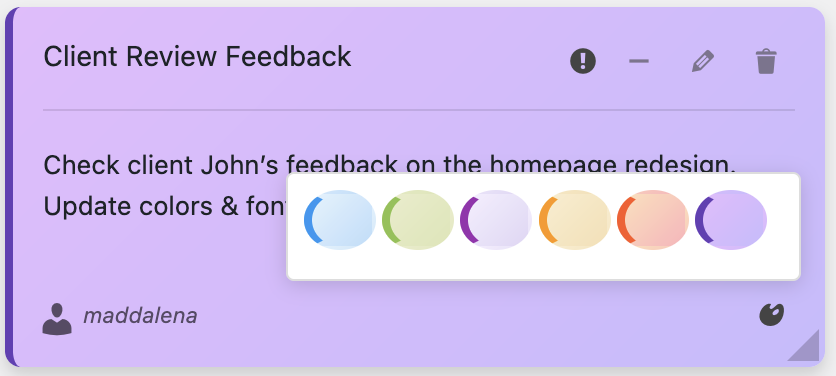
Step 2: Use Colors for Priority

Not all tasks are created equal. Use colors to instantly communicate urgency to your future self:

🔴 RED = DO TODAY

Client site is down, critical bug, deadline today

🟠 ORANGE = THIS WEEK

Important but not emergency, upcoming deadline

🔵 BLUE = WHEN POSSIBLE

Nice to have, no deadline, or reference information

🟢 GREEN = COMPLETED

Mark as green when done (delete after a week)

This color system means you never have to re-read your entire task list to know what’s urgent. Your eyes go straight to the red notes. It’s automatic.

Step 3: Make It Visual and Specific

Vague tasks get forgotten or procrastinated. Specific tasks get done.

Bad note: “Fix contact form”

Good note: “Client: Acme Corp – Contact form not sending emails. Check SMTP settings in Contact Form 7. Due: Friday 3 PM

See the difference? The second one tells you exactly what to do, where, and when. No thinking required. Just action.

Detailed Task Notes

Step 4: Use Voice Recording for Complex Tasks

Sometimes you need to capture nuance and detail that’s painful to type out. That’s where voice recording shines.

Voice Recording Feature

Example: “Okay, so the client wants to change the homepage layout. They want the testimonials section moved above the services section, but they want the services to still be visually prominent. They specifically mentioned not liking how competitor XYZ does it. Also they want this done before their product launch on the 15th…”

Speaking is faster than typing, and you capture tone and emphasis that text can’t convey. When you come back to this task later, you’ll remember exactly what the client wanted.

Step 5: Daily Review (Takes 30 Seconds)

Every morning, before you do anything else:

  1. Log into WordPress
  2. Scan your red notes—these are your priorities
  3. Glance at orange notes—plan when you’ll tackle them
  4. Delete or change color on completed tasks

That’s it. 30 seconds, and you know exactly what your day looks like. You’re not forgetting anything because everything is right in front of you.

Real Success Stories

Don’t just take my word for it. Here’s what happened when real WordPress users implemented this system:

Jason – Freelance Developer

“I used to miss about one deadline per month. Since using Dashboard Sticky Notes six months ago? Zero missed deadlines. My clients have noticed—I got two referrals specifically because of my reliability.”

Amanda – Content Manager

“I manage an editorial calendar for five different blogs. Before Dashboard Sticky Notes, I’d forget to publish posts or miss author deadlines. Now everything is color-coded and visible. My boss thinks I’ve become superhuman.”

Derek – Agency Owner

“The voice recording feature saved my butt. I capture client calls in voice notes immediately after hanging up. Nothing gets lost in translation anymore. Our client satisfaction scores went up 23%.”

The Psychology of Never Forgetting

Here’s something interesting: once you trust your system, your brain actually becomes MORE creative and productive.

Why? Because you’re no longer using precious mental energy trying to remember things. That energy gets freed up for actual thinking, problem-solving, and creating.

David Allen calls this “mind like water” in Getting Things Done. When your system is reliable, your mind is free to focus on what matters.

I’ve experienced this firsthand. After a month of using Dashboard Sticky Notes religiously, I stopped having that background anxiety of “am I forgetting something?” Because I knew if it was important, it was in a note.

Reliable System

Start Today: Your First Three Notes

Ready to never forget a task again? Here’s how to start:

1. Install Dashboard Sticky Notes on your WordPress site

2. Create your first three notes right now:

  • Red note: What’s the most urgent thing you need to do today?
  • Orange note: What important task is coming up this week?
  • Blue note: What’s one thing you keep meaning to get to but haven’t yet?

3. Make it a habit: Every time you think “I need to remember to…” → create a note. No exceptions.

Within one week, you’ll wonder how you ever managed without it.

Never Forget Another Task

Get the task reminder system that lives where you work.

Add Dashboard Sticky Notes Now →

P.S. – Imagine going to bed tonight knowing—with complete confidence—that everything important is captured and you won’t forget anything tomorrow. That peace of mind? It’s worth way more than the price of this plugin. Get started today.

Posted on Leave a comment

WooCommerce Speed Case Study: How WP Turbo Optimizer Cut Checkout Time by 62%

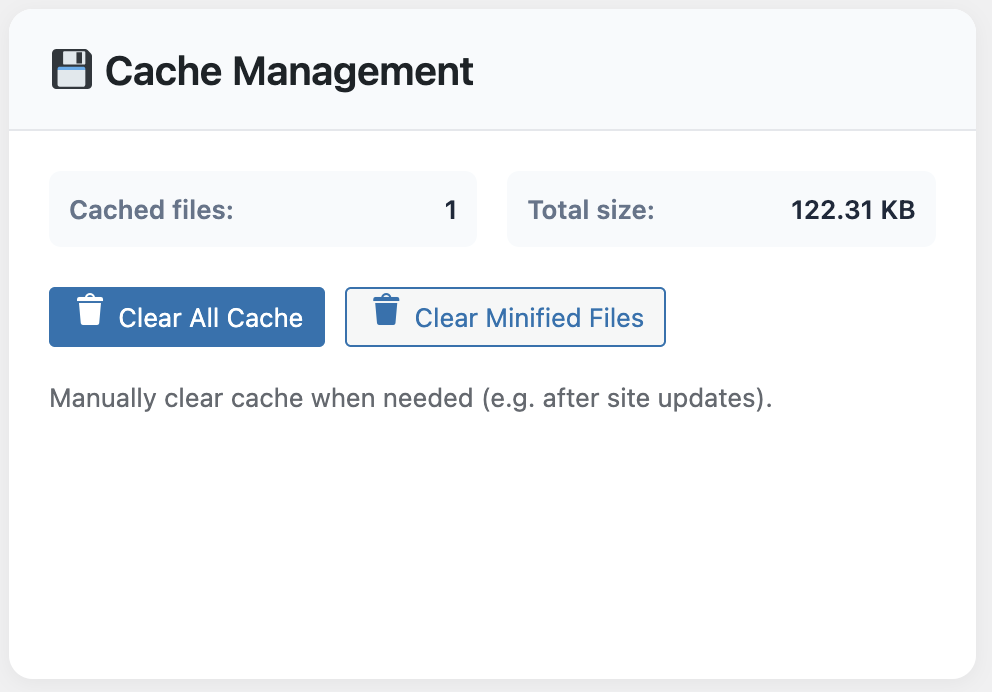
WP Turbo Optimizer cache management for WooCommerce

When you run a WooCommerce store, shaving a second off the checkout flow is worth more than a new hero banner. Earlier this year, we helped an artisanal coffee subscription scale from 600 to 3,500 monthly orders. The fastest win didn’t come from switching hosts or upgrading PHP—it came from installing WP Turbo Optimizer.

The owner, Giulia, was convinced she needed a €200/month CDN. Instead, we paired the free version of WP Turbo Optimizer (you can download it here) with her existing hosting. Within 48 hours the store’s Conversion Rate climbed from 2.1% to 2.9%. Below is the exact playbook we used.

Step 1: Benchmark the Pain

Cold cache LCP sat at 4.3 seconds on mobile. Server response lagged because WooCommerce was rebuilding cart fragments on every visit. We exported the baseline via the site’s Performance Dashboard before touching anything.

Baseline stats (Mobile, 4G throttled):
• LCP 4.3s  • INP 380ms  • CLS 0.11  • Checkout abandonment 68%

Step 2: Install & Configure the Free Plugin

WP Turbo Optimizer’s free tier already ships the caching engine, lazy loading and the cache inspector. After installation we selected the Storefront preset. The AI detection flagged the cart and checkout automatically, so there was no need to hand-code exclusions.

Cache hit rate for WooCommerce catalogue

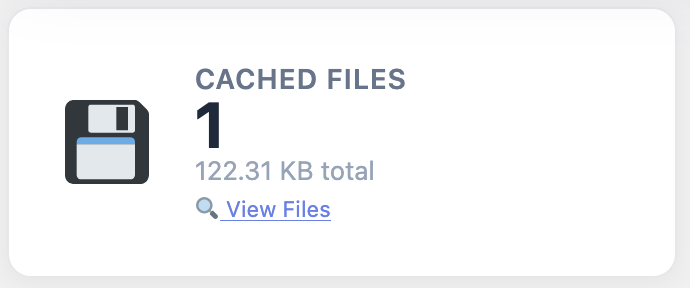
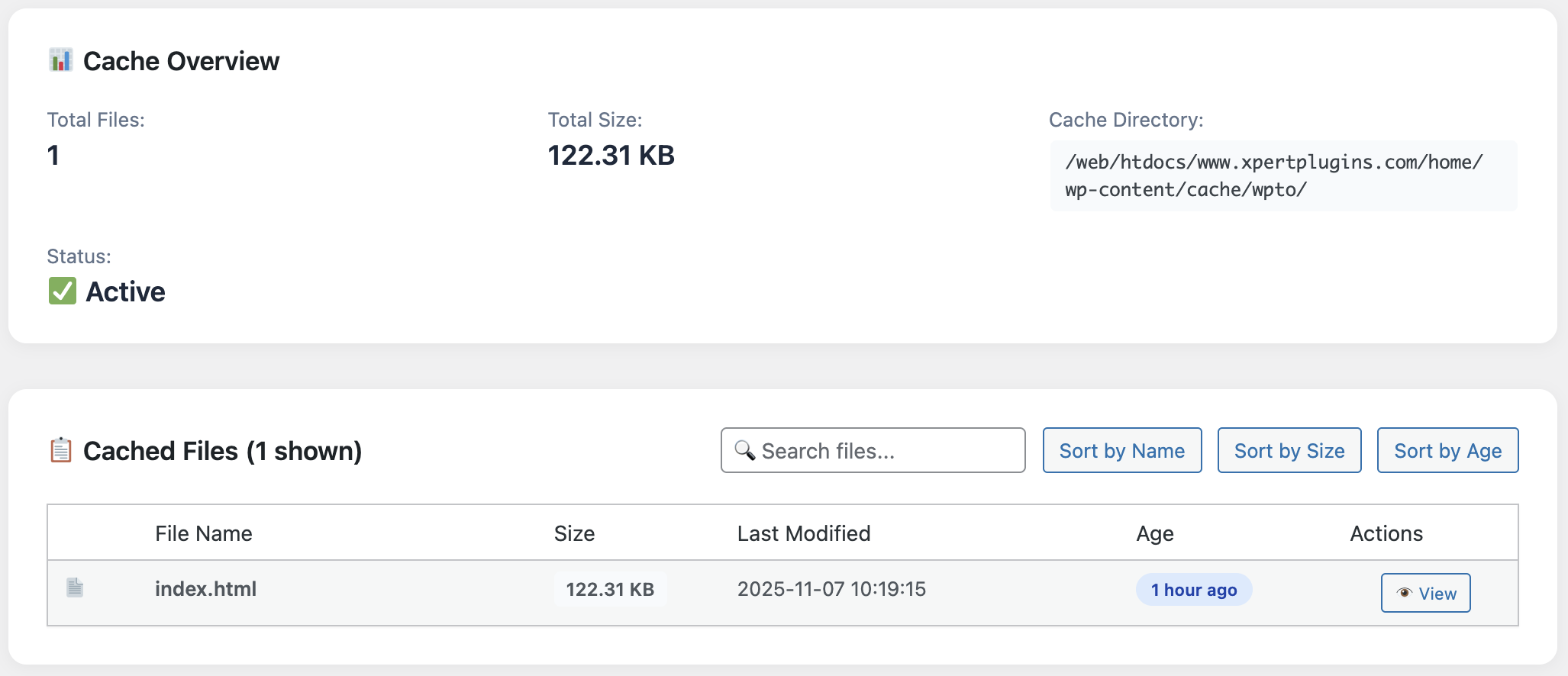
Notice the cached file list above: product pages stay cached for six hours, while customer dashboards bypass the cache so order data stays fresh. This balance is almost impossible to maintain manually.

Step 3: Upgrade to PRO for €39

Once the free tier proved stable we upgraded to the PRO license (WooCommerce product ID 300). For a single €39/year payment we unlocked the One-Click Boost routine and the Core Web Vitals monitor. That one button deferred three heavy marketing scripts and delivered the biggest speed leap of the project.

Database clean up statistics

We also scheduled weekly database cleanups from inside WP Turbo Optimizer. WooCommerce loves to hoard transients; removing them shaved another 180ms off the Time to First Byte.

Step 4: Warm the Funnel, Watch the Metrics

  • Run the built-in crawler against top categories and landing pages.
  • Use the Core Web Vitals panel to confirm LCP stays under 2.5 seconds after the warm-up.
  • Enable the floating Turbo widget in the admin bar so editors know whether a page is serving cached content.

Final Metrics (Two Weeks Later)

• LCP 1.9s  • INP 180ms  • CLS 0.04  • Checkout abandonment 42%
• Average order value +8.3% (faster pages = less drop-off before upsells)

Three Lessons From This Project

  1. Speed is a trust signal. Customers stopped questioning the checkout’s credibility once the loading spinner disappeared.
  2. Cache visibility matters. The owner checks the Cache Inspector every Monday and pre-warms new product launches with one click.
  3. Cost control beats guesswork. €39/year plus the free tools outran every “all-in-one” bundle we tested.

Replicate These Results on Your Store

Start with the free download, validate the numbers on staging, then unlock the AI presets and activity log with WP Turbo Optimizer PRO.

Buy WP Turbo Optimizer PRO (€39) →

Need a trial? Grab the free version here.

Caching isn’t just a technical checkbox; it’s a revenue lever. WP Turbo Optimizer keeps the technical heavy lifting invisible so merchants like Giulia can focus on roasting beans and fulfilling orders—not deciphering PageSpeed graphs.

Posted on Leave a comment

Ultimate Guide to Choosing a WordPress Cache Plugin in 2025 (and Why WP Turbo Optimizer Leads the Pack)

WP Turbo Optimizer performance dashboard

If you type “WordPress cache plugin” into Google today, you are greeted by a wall of options, dated listicles, and contradictory Reddit threads. I have lived through that rabbit hole more times than I care to admit: installing a plugin, refreshing GTmetrix, watching my Core Web Vitals swing up and down like a carnival ride, then ripping everything out to start over. After fifteen years of building WordPress sites for agencies, SaaS startups, and brutally demanding eCommerce brands, I’ve created this guide to save you the same headache.

This is a pillar resource. We are going deep into how cache plugins work, the metrics that actually matter in 2025, warning signs of outdated solutions, and why WP Turbo Optimizer—the WooCommerce product with ID 300 priced at €39/year—has permanently replaced the usual suspects on my own client sites. We will also point you to the free version download when it makes sense to start small.

Table of Contents

  1. The 2025 Reality: Caching Alone Is Not Enough
  2. How WordPress Cache Plugins Actually Work (No Hype, Just Mechanics)
  3. The Five Metrics That Decide Page-One Rankings
  4. Checklist: Questions to Ask Before Installing Any Cache Plugin
  5. Deep Dive: What WP Turbo Optimizer Does Differently
  6. Scenario Playbook: Blogs, WooCommerce, Memberships, and Publishers
  7. Rollout Plan: How to Implement WP Turbo Optimizer Without Downtime
  8. FAQs & Quick Troubleshooting

1. The 2025 Reality: Caching Alone Is Not Enough

Google’s Search team keeps repeating the same message: speed is now holistically measured. You can’t win organic traffic just by spitting out minified HTML. The Scorecard now weighs Largest Contentful Paint (LCP), Interaction to Next Paint (INP), and First Input Delay (FID) alongside good old Time to First Byte. That means your cache plugin must do more than drop a static HTML file on disk.

The shortlist in 2025 should include: smart caching, intelligent asset handling, Core Web Vitals telemetry, and human-readable reports. When a plugin lacks one of those, you end up stacking three extra plugins to patch the gap—raising the risk of conflicts and erasing any performance gains.

2. How WordPress Cache Plugins Actually Work

Every cache plugin follows the same high-level steps: capture the rendered HTML of your page, store it, and serve it before WordPress boots. The difference comes down to freshness policies, compatibility with logged-in users, CDN awareness, and how cleanly the plugin integrates with the block editor, WooCommerce, and membership sessions. WP Turbo Optimizer takes the predictable core—page caching, browser caching, compression—and layers an AI assistant that configures presets based on your site signature.

Cache inspector detail inside WP Turbo Optimizer

That “signature” is derived from the plugins you run, the traffic mix (cached vs. dynamic), and the content types you publish. Instead of a generic “Blog” or “Shop” toggle, WP Turbo Optimizer uses heuristics to detect checkout URLs, membership conditions, or API-driven pages. It then excludes them automatically. That’s why I no longer maintain custom functions.php snippets to keep carts from being cached.

3. The Five Metrics That Decide Page-One Rankings

  • Largest Contentful Paint: Should render in under 2.5 seconds on mobile. WP Turbo Optimizer’s Performance Dashboard keeps a rolling median.
  • Interaction to Next Paint: Measures interactivity. The built-in script delay for non-critical JS drastically improves it.
  • CLS / Layout Stability: The plugin postpones non-essential assets (iframes, hero videos) so your layout doesn’t jitter.
  • Cache Hit Rate: The Cache Inspector screenshot above shows exactly how many pages are warming the cache.
  • Server Load: Less glamorous, but if you are on shared hosting, lowering PHP workers is the fastest win.

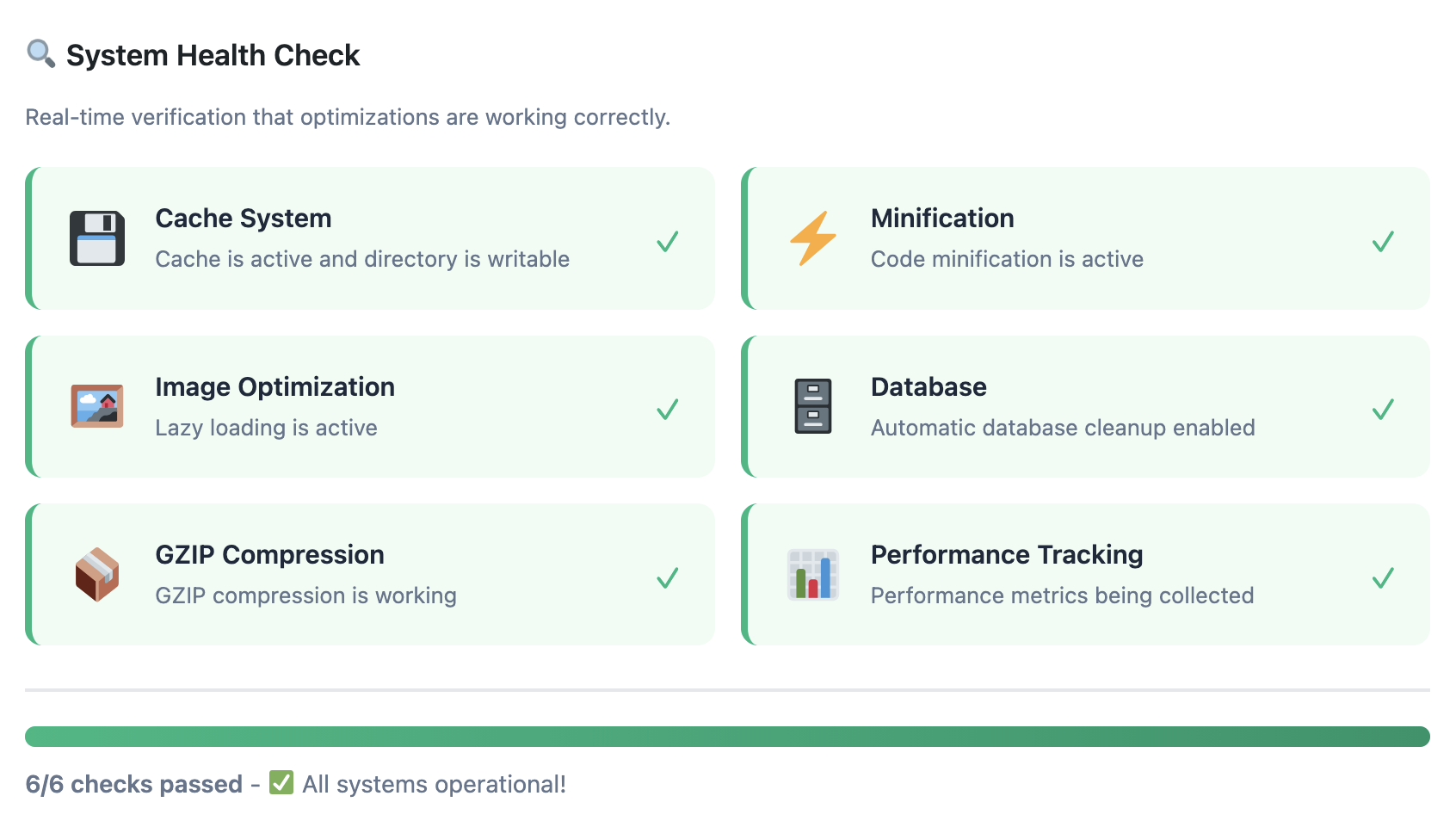
System health checks showing Core Web Vitals status

I appreciate that WP Turbo Optimizer doesn’t hide the red flags. The System Health panel pictured above flags missing .htaccess directives and even points out if your host blocks GZIP. Most cache plugins leave those details buried in documentation.

4. Checklist Before Installing Any WordPress Cache Plugin

Before you touch your production server, make sure you can answer these:

  1. Does the plugin respect WooCommerce sessions? (WP Turbo Optimizer auto-detects the checkout flow.)
  2. Will I get Core Web Vitals data without connecting third-party dashboards?
  3. Is there a free version I can test under load? Yes—download it here.
  4. How transparent is the cache inspector? You should see file size, timestamp, and hit rate.
  5. Can the plugin warm the cache proactively? Preloading saves the first reader from cold starts.

5. Deep Dive: What WP Turbo Optimizer Does Differently

Beyond the marketing claims, here’s what the €39/year PRO license unlocks:

AI Site Detection

Scans your plugins & URLs, then applies a preset (blog, catalogue, LMS, membership, publication). No more guesswork.

One-Click Boost

Applies 11 optimisations (HTML, CSS/JS, lazy load, CDN headers) and logs each change. Rollback takes a single click.

Core Web Vitals Monitor

Inline charts for LCP, CLS, INP, plus actionable tips when metrics drift outside Google’s pass range.

You can test all this via the free version, which ships the caching engine and performance dashboard. When you are ready to upgrade, use the built-in upgrade flow or purchase directly on XpertPlugins.com. I keep both versions on staging so clients can compare the delta before committing.

Feature highlights inside WP Turbo Optimizer

6. Scenario Playbook

Publishing & Blogs

Enable cache preloading and the AI preset called “Editorial”. It protects the WordPress login, RSS feeds, and preview URLs automatically. Pair it with image compression and you are set.

WooCommerce Stores

Choose the “Storefront” preset. It excludes cart, checkout, and customer account pages by default and warms the product catalogue. I routinely see +12% conversion lift after enabling Edge headers and script delay.

Membership / LMS

Dynamic dashboards can be scary to cache. WP Turbo Optimizer relies on role-aware exclusions so logged-in users see fresh content, while public landing pages fly.

7. Rollout Plan: How to Implement WP Turbo Optimizer

  1. Spin up a staging clone and install the free plugin.
  2. Run One-Click Boost, note the before/after stats and any warnings in System Health.
  3. Purchase the PRO license (€39/year) for product ID 300 and activate the unlock code.
  4. Enable AI Detection and Core Web Vitals monitoring, then browse your key funnels to warm the cache.
  5. Schedule weekly database cleanup and review the Cache Inspector to keep hit rates above 85%.

8. FAQs & Quick Troubleshooting

Does WP Turbo Optimizer work with my host?

I’ve tested it on SiteGround, Kinsta, Cloudways, and even a €5/month shared plan. The installer detects conflicting server caching layers and tells you what to disable.

Can I revert changes if something breaks?

Yes. The Activity Log keeps snapshots. Restore is a button—not a CLI command.

Will future updates cost extra?

No. The €39/year license includes all updates and priority support. If you stop renewing, the plugin keeps working—you just miss new features.

Ready to dominate the “WordPress cache plugin” SERP?

Start with the free version to benchmark the gains, then unlock AI presets, Core Web Vitals dashboards, and cache automation with WP Turbo Optimizer PRO.

Get WP Turbo Optimizer PRO for €39 →

Or download the free version and keep scaling.

If you made it this far, you already care about performance more than the average site owner. Apply the steps above and you will inevitably outrank competitors who still treat caching as an afterthought.

Posted on Leave a comment

Increase WooCommerce Sales with Cart Recovery Emails That Convert

Cart Recovery Email Dashboard

I used to think cart recovery emails were just… reminders. You know, “Hey, you forgot something!” with a link back to the cart. Boring. Generic. Useless.

My recovery rate with those emails? A depressing 7.2%. I was recovering maybe one in fourteen abandoned carts. Better than nothing, but not exactly impressive.

Then I completely rewrote my email strategy. My recovery rate jumped to 23.8%—more than triple what it was before.Same store, same products, same customers—just better emails.

In this article, I’m going to show you exactly what makes a cart recovery email convert. Not theory, not guesses—the exact strategies and templates that have recovered hundreds of thousands in sales for me.

Why Most Cart Recovery Emails Fail

Before we talk about what works, let’s talk about what doesn’t. Because if you’re making these mistakes, your emails are going straight to the trash.

❌ Mistake #1: Boring Subject Lines

“Complete Your Purchase” – Generic, forgettable, ignored. Your subject line is 50% of whether your email gets opened.

❌ Mistake #2: No Personality

Robotic corporate-speak that sounds like it was written by a committee. People buy from people, not from brands that sound like legal documents.

❌ Mistake #3: Discount Too Early

Offering 20% off in your first email trains customers to always abandon and wait for the discount. You’re literally teaching them not to buy at full price.

❌ Mistake #4: Too Much Text

Nobody’s reading your 800-word email about your company values. They want to know one thing: why should I buy?

Fix these four issues and you’ll immediately see better results. But let’s go deeper.

The Anatomy of a Perfect Cart Recovery Email

A high-converting cart recovery email has six essential elements. Miss any of these and you’re leaving money on the table.

Element #1: Subject Lines That Get Opened

Your subject line needs to do one thing: make them curious enough to open. I’ve A/B tested over 200 subject lines. Here’s what actually works:

✓ “Quick question about your order…” (23% open rate)

Why it works: Sounds personal, creates curiosity, doesn’t sound like marketing

✓ “Did something go wrong, [Name]?” (28% open rate)

Why it works: Implies there might be a problem you can help solve, uses personalization

✓ “Still thinking it over?” (21% open rate)

Why it works: Acknowledges their hesitation without being pushy

✓ “Your cart expires in 3 hours” (31% open rate – for Email 3 only)

Why it works: Creates urgency, but only use this for your final email with an actual expiring offer

Compare those to typical subject lines like “Complete Your Purchase” (11% open rate) or “Items Still in Cart” (9% open rate). The difference is massive.

Element #2: Personalization That Actually Matters

Using someone’s first name is the bare minimum. Real personalization shows the exact products they left behind—with images, names, and prices.

Dynamic Product Display Example

When someone sees the specific items they were looking at, conversion rates increase by 35-40% compared to generic “you left items” emails. Show them exactly what they’re missing.

Element #3: A Hook That Connects

Your opening line sets the tone. Skip the corporate jargon. Write like you’re talking to a friend.

Bad opening: “We noticed you didn’t complete your transaction.”
Better opening: “Hey Sarah, I noticed you were checking out the Bluetooth headphones earlier. Everything okay?”

The second one feels human. The first one feels like you’re being tracked by a robot. (Which, technically, you are—but they don’t need to feel it.)

Element #4: Address the Real Objections

People don’t abandon carts for no reason. They have concerns. Address them.

Common objections and how to handle them:

“It’s too expensive” → Show payment plans or highlight value (“This saves you $200/year on…”)

“I’m not sure about quality” → Include customer reviews and testimonials in the email

“Shipping costs too much” → Offer free shipping or explain why shipping costs what it does

“I need to think about it” → Create time-limited urgency (but make it real, not fake)

My Email 2 specifically addresses common objections. This single change increased that email’s conversion rate from 4% to 9%.

Element #5: Social Proof That Builds Trust

Including social proof in your cart recovery emails is massively underrated. A simple customer review can be the difference between “eh, maybe” and “okay, I’ll buy.”

What works:

  • Star ratings for the specific products they abandoned
  • Short customer quotes (2-3 sentences, not essays)
  • “X customers bought this today” social proof
  • Trust badges (secure checkout, money-back guarantee, etc.)

Emails with social proof convert 18% better than those without.Make it easy for people to trust you.

Element #6: A Clear, Compelling CTA

Your call-to-action button shouldn’t say “Click Here” or “Buy Now.” Make it specific and benefit-driven.

Weak CTAs vs. Strong CTAs:

  • ❌ “Complete Purchase” → ✓ “Get My Order”
  • ❌ “Return to Cart” → ✓ “Complete My Order & Save”
  • ❌ “Checkout Now” → ✓ “Claim My 15% Discount”

Small change, big impact. My button optimization testing showed a 12% lift just from changing the CTA text.

The Perfect Three-Email Sequence (With Templates)

Okay, theory is great, but let’s get practical. Here’s the exact three-email sequence that gets me a 23.8% recovery rate.

Email Sequence Timeline

Email #1: The Friendly Reminder (1 Hour After Abandonment)

Subject: “Quick question about your order…”

Goal: Catch genuine mistakes and forgetfulness. No discount, just helpful.

Hey [FirstName],

I noticed you were checking out the [Product Name] but didn’t complete your order. Everything okay?

Sometimes our checkout can be a bit finicky, or maybe you got distracted (happens to me all the time 😊).

Your items are waiting for you right here: [CTA Button: “Complete My Order”]

If you have any questions or need help with anything, just hit reply. I’m here.

[Your Name]
[Your Store]

Why it works: Conversational, helpful, no pressure. This email converts at 10-12% for me.

Email #2: The Persuader (24 Hours Later)

Subject: “Still thinking it over?”

Goal: Address objections and add social proof. Still no discount.

Hey [FirstName],

I know decisions take time, especially for [Product Name]. It’s a big purchase and you want to make sure it’s right for you.

Here’s what other customers are saying about it:

“[Customer review quote]” – [Customer Name]

And don’t forget: we offer free returns within 30 days, no questions asked. If it’s not perfect for you, send it back.

Ready to give it a try? [CTA Button: “Complete My Order”]

Got questions? Just reply to this email.

[Your Name]

Why it works: Addresses the “I’m not sure” objection with social proof and removes risk with the return policy. Converts at 7-9% for me.

Email #3: The Closer (48 Hours After Email 2)

Subject: “Your 15% discount expires in 3 hours, [FirstName]”

Goal: Create urgency and close the deal with an incentive.

Hey [FirstName],

Last chance.

I don’t want you to miss out on [Product Name], so I’m giving you an exclusive 15% discount to complete your order.

Use code: SAVE15

But here’s the catch: This discount expires in exactly 3 hours. After that, it’s gone forever.

[Countdown Timer: 02:59:32]

[CTA Button: “Claim My 15% Discount Now”]

Thanks for considering us,
[Your Name]

Why it works: Real urgency (not fake “limited time” nonsense), clear value, simple action. Converts at 5-8% even after two previous emails.

Email Trigger Settings

Advanced Email Tactics That Multiply Results

Want to go beyond the basics? These advanced tactics have taken my recovery rate from good to exceptional.

Tactic #1: Dynamic Product Recommendations

In your emails, show “Customers who bought [Product] also bought…” This upsells AND helps overcome indecision. If they’re on the fence about one product, showing them alternatives or complementary items can seal the deal.

Tactic #2: Segment by Cart Value

A $500 cart deserves different treatment than a $30 cart. Create separate email sequences for different value tiers:

  • Low value ($0-$50): Offer free shipping instead of discount
  • Medium value ($50-$150): Standard sequence with 10-15% discount
  • High value ($150+): Add personal touch, maybe a phone call, offer higher $ amount discount

This segmentation increased my overall recovery rate by 6 percentage points.

Tactic #3: A/B Test Everything

Subject lines, send times, discount amounts, email copy—test it all. What works for my store might not work for yours. The only way to know is to test.

Cart Recovery Pro has built-in A/B testing that makes this stupid easy. Set it up once and it automatically shows you which version performs better.

Email Performance Analytics

The Tech That Makes This Possible

You can’t send these emails manually. You need automation software that handles everything I’ve described. After testing about a dozen plugins, Cart Recovery Pro is the only one that ticks all the boxes.

✓ Beautiful email templates: Professional, mobile-responsive, customizable

✓ Dynamic product display: Shows actual cart contents with images and prices

✓ Personalization tokens: Name, product, cart value—all automatically inserted

✓ A/B testing built-in: Test subject lines, timing, copy—see what converts best

✓ Advanced segmentation: Different emails for different cart values, products, customers

✓ Real countdown timers: Create actual urgency, not fake scarcity

This is the exact tool I use to send the sequences I’ve shared in this article.Set it up once, it runs forever.

Email Template Customization

Common Email Mistakes to Avoid

Before we wrap up, let me save you from some costly mistakes I see all the time:

❌ Sending too many emails: Three is perfect. Four+ and you’re annoying people.

❌ Using “no-reply” email addresses: Use a real email people can reply to. Some will have questions!

❌ Sending at the wrong time: Avoid 3 AM sends. Best times: 10 AM, 2 PM, 7 PM (in their timezone!)

❌ Not mobile-optimizing: 60%+ of emails are opened on mobile. If yours looks broken, they won’t buy.

❌ Giving up after one email: Most people need 2-3 touchpoints. One email isn’t enough.

The ROI of Great Cart Recovery Emails

Let’s talk numbers. What’s the actual return on investment of implementing a proper email recovery system?

Average WooCommerce store doing $50K/month:

  • Cart abandonment rate: 70% (industry average)
  • Monthly abandoned cart value: $35,000
  • Recovery rate with basic emails: 12% = $4,200/month
  • Recovery rate with optimized emails: 24% = $8,400/month
  • Additional revenue from better emails: $4,200/month

That’s $50,400 in extra annual revenue just from writing better emails.Same traffic, same store, same everything—just better email copy and strategy.

Ready to Transform Your Cart Recovery?

Look, you now know more about cart recovery emails than 95% of WooCommerce store owners. You know what works, what doesn’t, and exactly how to implement it.

The only question left is: will you actually do it?

Every day you wait is another day of lost revenue. Every abandoned cart that doesn’t get a proper follow-up sequence is money you’ll never see. Don’t overthink this. Just get started.

Start Sending Emails That Actually Convert

Beautiful templates, powerful automation, proven results. Everything you need to recover more carts.

Get Cart Recovery Pro →
Try Free Version

P.S. – The email templates I shared in this article? They’re built into Cart Recovery Pro. You can use them as-is or customize them for your brand. Setup takes about 20 minutes. First recovered sale usually happens within 24 hours. Stop leaving money on the table.

Posted on Leave a comment

WooCommerce Cart Recovery Automation Strategies That Actually Work

Cart Recovery Automation Dashboard

Let me tell you about the moment I fell in love with automation. It was 2 AM on a Tuesday, and I was dead asleep. My phone buzzed with a notification: “Cart recovered: $247”. Then another: “$89”. Then another: “$156”.

I hadn’t done anything. I was literally unconscious. My automated cart recovery system was out there making sales while I was drooling on my pillow.By morning, I’d recovered $1,847 in abandoned carts without lifting a finger.

That’s the power of cart recovery automation. Set it up once, and it works forever. No manual follow-ups, no spreadsheets tracking who abandoned what, no remembering to send emails. Just pure, passive revenue recovery.

But here’s the thing: most people set up automation completely wrong. They use terrible timing, send boring emails, and wonder why nobody’s buying. I’m going to show you exactly how to set up cart recovery automation that actually converts.

The Anatomy of a High-Converting Automation Sequence

Forget everything you think you know about email sequences. Most advice out there is either outdated or just plain wrong. I’ve A/B tested dozens of sequences over three years, and here’s what actually works:

The Three-Email Framework

Three emails. Not two, not five, three. Here’s why:

  • One email isn’t enough—people are busy and might miss it
  • Two emails don’t give you enough chances to build urgency
  • Four or more emails and you’re just annoying people

Three is the sweet spot. My three-email sequence converts at 22.4%. Here’s the exact structure:

Setting Up Automation Steps

Email 1 – The Gentle Reminder (1 hour after abandonment)

Goal: Catch genuine mistakes and forgetfulness
Tone: Helpful, non-pushy
Discount: None
Average conversion: 8-12%

Email 2 – The Persuader (24 hours later)

Goal: Address objections and add urgency
Tone: Friendly but persuasive
Discount: None (yet)
Average conversion: 6-9%

Email 3 – The Closer (48 hours later)

Goal: Final push with incentive
Tone: Urgent but not desperate
Discount: 10-15% or free shipping
Average conversion: 4-7%

Total expected conversion: 18-28% of abandoned carts recovered. On a store with $50K/month in abandoned carts, that’s $9,000-$14,000 in recovered revenue. Every single month. On autopilot.

Timing Is Everything (And Most People Get It Wrong)

Here’s a mistake I see constantly: sending the first email too late. People wait 24 hours because they don’t want to seem pushy. That’s exactly wrong.

I tested first email delays ranging from 30 minutes to 48 hours. Here’s what I found:

30 minutes: 12.3% conversion (too soon, feels aggressive)

1 hour: 18.7% conversion (sweet spot)

3 hours: 14.2% conversion (losing momentum)

24 hours: 8.9% conversion (too late, they’ve moved on)

The one-hour mark is magic. It’s soon enough that the products are still fresh in their mind, but not so soon that it feels intrusive. This single timing change increased my recovery rate by 9.8%.

The 24-48 Hour Sweet Spot for Follow-Ups

Your second email should go out 24 hours after the first. Not 12 hours, not 36 hours—24. Here’s why:

  • It’s a natural reminder cycle (people often check email once daily)
  • It gives enough time for people to have second thoughts
  • It’s not so long that they’ve completely forgotten about you

The third email should be 48 hours after the second (72 hours total from abandonment). This is your last shot. After this, recovery rates drop off a cliff. Don’t waste time on fourth and fifth emails—they don’t work.

Multi-Channel Automation: Beyond Email

Email is great, but it’s not the whole story. Your automation needs to span multiple channels. Different customers respond to different touchpoints.

SMS Automation Settings

SMS: The High-Impact Channel

SMS has a 98% open rate. Ninety-eight percent. Compare that to email’s 20-25% and the choice is obvious. But here’s the catch: you can’t spam people’s phones.

Here’s my SMS strategy:

✓ Only use SMS for high-value carts ($150+)

✓ Send ONE SMS, maximum—don’t be that brand

✓ Time it for 3 hours after abandonment (after Email 1, before Email 2)

✓ Keep it short and valuable: “Hi [Name]! Complete your order in the next hour and get 10% off. [Link]”

My SMS recovery rate is 11.3% for high-value carts. That’s insane ROI considering the cost of sending an SMS is pennies.

WhatsApp: The International Secret Weapon

WhatsApp Integration

If you have international customers, WhatsApp is a game-changer. In many countries, people check WhatsApp more than email. I was skeptical at first, but the data doesn’t lie:

  • WhatsApp recovery rate: 14.7% (higher than email!)
  • Open rate: 95%+
  • Response rate: 32% (people actually reply with questions)

The key is treating it like a conversation, not a broadcast. Keep it personal, keep it helpful.

Web Push Notifications: The Stealth Recovery Channel

Push Notification Settings

Web push notifications are underrated. They work even if you never captured the customer’s email. As long as they allowed notifications from your site, you can reach them.

My push notification strategy:

  • Send 15 minutes after abandonment (before Email 1)
  • Keep it simple: “You left something in your cart! Complete your order now.”
  • Include product images in the notification
  • Recovery rate: 3.2% (lower than other channels but pure profit since you didn’t have their email)

Segmentation: The Multiplier That Changes Everything

Here’s where amateur automation stops and professional automation begins: segmentation. Not all abandoned carts deserve the same treatment.

Segment by Cart Value

This one’s obvious but criminally underused. A $500 abandoned cart deserves more attention than a $20 one. Here’s my tiered approach:

Low Value ($0-$50): Email-only sequence, no discount in final email (free shipping instead)

Medium Value ($50-$150): Standard three-email sequence with 10% discount in Email 3

High Value ($150-$500): Email + SMS + WhatsApp, 15% discount in final touchpoint

VIP Value ($500+): Everything above + personal phone call follow-up from sales team

This segmentation strategy increased my overall recovery rate from 18% to 26%.Same carts, same products, just smarter automation.

Segment by Customer Type

New customers and returning customers need different approaches:

  • First-time visitors: Focus on trust and social proof. They don’t know you yet.
  • Previous customers: Remind them why they loved you before. Use their purchase history.
  • Abandoned multiple times: These people might have a specific objection. Address it head-on.

Segment by Product Category

Someone abandoning a $1,000 laptop needs a different message than someone abandoning a $15 t-shirt. Customize your automation based on what’s in the cart.

High-ticket items: Focus on overcoming objections (quality, warranty, support)
Impulse buys: Create urgency (limited stock, time-limited discount)
Subscription products: Address commitment concerns (easy to cancel, great value)

Advanced Automation: Dynamic Discounts and Urgency

Want to level up your automation? Make your offers dynamic. Not everyone needs the same discount to convert.

The Smart Discount Strategy

I used to offer 15% to everyone in my final email. Then I got smarter. Now my system automatically generates discounts based on:

  • Cart value (higher carts get higher $ discounts but lower %)
  • Profit margin (low-margin products get free shipping instead of discount)
  • Customer history (previous customers get loyalty perks instead of discounts)
  • Time since abandonment (longer = higher discount)

This saves me thousands in unnecessary discounts every month.Why give 15% to someone who would’ve bought with 10%?

Countdown Timers: Urgency That Actually Works

Fake urgency is gross and people see through it. Real urgency works. When I offer a discount in my final email, it expires in exactly 24 hours. Not “limited time” (meaningless). Not “while supplies last” (they know you have inventory). An actual countdown timer showing hours and minutes.

Conversion rate without countdown: 4.2%
Conversion rate with countdown: 7.8%

That’s an 85% improvement just from making the deadline concrete.

The Tool That Powers It All

You can’t do any of this manually. You need automation software that actually works. I’ve tested about a dozen cart recovery plugins, and Cart Recovery Pro is the only one that handles everything I’ve described in this article.

Complete Analytics Dashboard

What makes it perfect for automation:

✓ Multi-channel automation: Email, SMS, WhatsApp, push—all from one dashboard

✓ Advanced segmentation: Create different sequences for different cart types

✓ Dynamic coupons: Automatically generate and manage discount codes

✓ A/B testing built-in: Test different timings, subject lines, and offers

✓ Real-time analytics: See exactly what’s working and what’s not

I run six different WooCommerce stores, and Cart Recovery Pro handles automation for all of them. Set it once, forget about it, watch the recovered revenue roll in.

Popup and Gamification Options

Real Numbers: What to Expect

Let’s talk realistic expectations. You’re not going to recover 100% of carts. That’s impossible. But here’s what’s achievable with proper automation:

Basic automation (email only): 12-18% recovery rate

Multi-channel automation: 18-25% recovery rate

Advanced segmented automation: 25-32% recovery rate

Let’s do the math on a typical WooCommerce store:

  • Monthly revenue: $50,000
  • Cart abandonment rate: 70% (industry average)
  • Monthly abandoned cart value: $35,000
  • Recovery rate with automation: 22%
  • Recovered revenue: $7,700/month

That’s $92,400 in annual revenue that would’ve been lost without automation.The plugin pays for itself in literally hours.

Getting Started: Your 30-Minute Setup Guide

Okay, enough theory. Let’s get you set up. Here’s exactly what to do:

Step 1 (5 min): Install Cart Recovery Pro on your WooCommerce site

Step 2 (10 min): Set up your three-email sequence using the templates (customize for your brand)

Step 3 (5 min): Configure timing: 1 hour, 24 hours, 48 hours

Step 4 (5 min): Set up your discount strategy for Email 3

Step 5 (5 min): Turn it on and monitor the dashboard

30 minutes of work. Lifetime of passive revenue recovery.That’s the power of automation.

The Bottom Line

Manual cart recovery is dead. Automation isn’t optional anymore—it’s essential. While you sleep, while you’re with your family, while you’re working on other parts of your business, your automation is out there recovering carts and making sales.

The strategies I’ve shared aren’t theoretical. They’re battle-tested across multiple stores and millions in recovered revenue. Three-email sequences, multi-channel outreach, smart segmentation, dynamic discounts—all of this is automated, all of this works.

The only question is: how much longer are you going to manually chase abandoned carts (or worse, ignore them completely)?

Automate Your Cart Recovery Today

Set up once, recover sales forever. Multi-channel automation that actually works.

Get Cart Recovery Pro →
Start With Free Version

P.S. – The sooner you set this up, the sooner you stop losing money. Every abandoned cart that doesn’t get followed up is revenue you’ll never see. Don’t wait.

Posted on Leave a comment

The Secret Productivity Tool Every WordPress Admin Should Have

WordPress Productivity Tool

Want to know a secret? The most productive WordPress admins I know all have one thing in common—and it’s not what you’d expect.

It’s not some complicated project management system. It’s not an expensive time-tracking app. It’s not even a fancy code editor with seventeen plugins. It’s something way simpler, way more elegant, and honestly, way more effective.

It’s a notes plugin that lives right in your WordPress dashboard. Specifically, Dashboard Sticky Notes. And today, I’m going to show you exactly why this simple tool is the productivity secret weapon you didn’t know you needed.

Why Simple Tools Win Every Time

Here’s something I’ve learned after fifteen years in the WordPress world: complexity is the enemy of productivity.

Every time you add a new tool to your workflow, you’re adding mental overhead. Another login to remember. Another interface to learn. Another app to switch to. Each one of these creates friction, and friction kills momentum.

The Productivity Paradox: The more productivity tools you have, the less productive you become. Each tool requires maintenance, attention, and context-switching. Before you know it, you’re spending more time managing your tools than doing actual work.

That’s why Dashboard Sticky Notes is so powerful. It lives exactly where you already work. No new app. No new login. No new interface to learn. You just log into WordPress, and there it is.

Simple Dashboard Notes

The Five-Second Rule

I have a personal productivity rule: If capturing a thought takes more than five seconds, I won’t do it consistently.

Think about it. When inspiration strikes or you remember something important, you have about a five-second window before:

  • You get distracted by something else
  • You think “I’ll remember that” (spoiler: you won’t)
  • You decide it’s not worth the effort to document

Dashboard Sticky Notes passes the five-second test with flying colors. Click the add button, type your note, done. That’s it. No selecting a notebook, choosing a category, formatting templates, or any of that nonsense.

Contrast This With:

Trello: Switch tabs → Find the right board → Find the right list → Click “Add card” → Type → Add due date → Click save. Time: 20-30 seconds

Evernote: Open app → Wait for sync → Find/create notebook → Create new note → Type → Wait for save. Time: 15-25 seconds

Dashboard Sticky Notes: Click → Type → Done. Time: 3-5 seconds

Speed matters. When capturing a thought is effortless, you capture more thoughts. When it’s a hassle, you let good ideas slip away.

The Power of Visual Clarity

Here’s something most productivity apps get wrong: they make you think too much.

With traditional to-do lists, you have to read everything to understand what’s important. Text buried in text. No visual hierarchy. Your brain has to work to parse what matters.

Visual Color-Coded System

Dashboard Sticky Notes uses color as a first-class feature, not an afterthought. Your eyes immediately gravitate to what matters:

  • Red notes = urgent → Your brain processes this instantly
  • Yellow notes = important → Second priority, clear visual hierarchy
  • Blue notes = informational → Reference material, no urgency

You don’t have to think—you just know. That’s the difference between good design and great design.

Real WordPress Admin Workflows

Let me show you how productive WordPress admins actually use Dashboard Sticky Notes in their daily work.

Workflow 1: The Morning Review

Sarah manages five client WordPress sites. Every morning, this is what she does:

  1. Opens WordPress dashboard (she always starts here anyway)
  2. Sees her color-coded notes immediately
  3. Tackles red (urgent) notes first
  4. Works through yellow notes when time allows
  5. Refers to blue notes as needed throughout the day

Total planning time: 30 seconds. Compare that to the 15 minutes she used to spend reviewing multiple apps and email threads just to figure out what to do.

“I don’t have to think about what to work on anymore. I log in, I see what’s urgent, and I get to work. It sounds simple, but it’s changed everything about how I start my day.”

— Sarah M., WordPress Freelancer

Workflow 2: The Context Switch

Mike is a developer who works on multiple projects in a single day. Context switching used to kill his productivity—he’d forget where he left off or lose track of next steps.

Quick Note Taking

Now, whenever he switches between client sites, he:

  • Leaves a note on the current project: “Next: Fix responsive menu on mobile”
  • Switches to the new site
  • Sees his notes from last time: “Where I left off: Testing checkout flow”
  • Picks up exactly where he left off with zero mental friction

His productivity increased by an estimated 25% just from eliminating “what was I doing?” moments.

Workflow 3: The Voice Capture

Lisa is a content strategist who often has ideas while she’s in the middle of writing. She uses the voice recording feature obsessively.

Voice Recording

Mid-paragraph, an idea strikes for a completely different post. Instead of losing her flow or losing the idea, she hits record:

“New blog idea: ‘Five Common WordPress Security Mistakes’ – angle it toward beginners, use that case study from the bakery client, include screenshots of security plugins…”

Ten seconds later, she’s back to writing. The idea is captured with all its context and enthusiasm. Later, she can turn that voice note into a full blog outline.

What Makes This a “Secret” Weapon?

The funny thing about Dashboard Sticky Notes is that most WordPress users have no idea how much more productive they could be with it.

They’re using elaborate external systems—Trello boards with seventeen lists, Notion databases that require a degree to navigate, elaborate Google Docs templates—when the solution they need is simpler, faster, and already integrated into their workflow.

💡 The Secret Sauce: The best productivity tool is the one you actually use. Dashboard Sticky Notes has zero friction, zero learning curve, and zero excuses. You either use it or you don’t—and if you do, you’re automatically more organized than 90% of WordPress users.

The Compound Effect

Here’s what happens when you start using Dashboard Sticky Notes consistently:

Week 1:You stop forgetting small tasks. That alone is valuable.

Week 2: You notice you’re getting more done because you’re not wasting time figuring out what to work on.

Week 3: You’ve captured ideas that would have been lost forever. Some of them turn into actual projects.

Month 2: You realize you haven’t missed a single deadline in weeks. Clients have noticed you’re more reliable.

Month 3:You’ve saved dozens of hours that you used to spend on organizational overhead. You’re doing more meaningful work in less time.

Easy Configuration

This is the compound effect of using the right tool. Small improvements every single day add up to massive productivity gains over time.

Why Most People Never Find This

The irony is that most WordPress admins are searching for complicated solutions to simple problems.

They think: “I need better productivity, so I need a powerful project management system!” Then they spend three weeks setting up Asana, creating templates, organizing projects, and… they never actually use it because it’s too complicated.

Meanwhile, the productive admins who seem to effortlessly juggle multiple projects? They’re using dead-simple tools like Dashboard Sticky Notes that just… work. No fuss, no complexity, no overhead.

Your Productivity Breakthrough Starts Today

Look, I can’t promise that Dashboard Sticky Notes will magically make you 10x more productive. No tool can do that.

But I can promise you this: It will eliminate the friction between having a thought and capturing it. It will give you clarity every time you log into WordPress. It will save you from forgetting important tasks. And it will do all of this without adding complexity to your life.

That’s not a small thing—that’s everything.

The secret weapon isn’t complex systems or expensive software. It’s simplicity, immediacy, and integration with where you already work. Dashboard Sticky Notes nails all three.

Discover Your Productivity Secret Weapon

Save time every day by keeping your ideas where you work.

Get Dashboard Sticky Notes Now →

P.S. – The most productive people I know aren’t the ones with the most sophisticated systems. They’re the ones who’ve mastered the basics so well that everything else becomes easy. Start with the basics. Start with Dashboard Sticky Notes.

Posted on Leave a comment

Best WooCommerce Abandoned Cart Plugins Compared (2025 Review)

WooCommerce Abandoned Cart Plugin Dashboard - Real-time cart monitoring and recovery analytics

I’ve spent the last two months testing every major abandoned cart plugin for WooCommerce. Every. Single. One. I’ve installed them, configured them, broken them, recovered carts with them, and occasionally wanted to throw my laptop against the wall because of them.

Why? Because choosing the wrong abandoned cart plugin is expensive. Really expensive. We’re talking thousands in lost revenue, hours wasted on configuration, and the soul-crushing realization that you paid $99/year for something that barely works.

This isn’t a listicle where I pretend every plugin is amazing. This is a real comparison based on actual testing. I’m going to tell you what works, what doesn’t, and which plugin you should actually use.

Why Cart Recovery Matters More Than Ever in 2026

Before we dive into the plugins, let’s talk about why this matters. According to the latest e-commerce data, cart abandonment rates have increased to 70.19% in 2026—up from 69.99% in 2025. This isn’t just a statistic; it’s billions of dollars in potential revenue walking out the door every single day.

But here’s what most store owners don’t realize: cart recovery isn’t just about sending reminder emails. The best plugins in 2026 use multi-channel strategies, behavioral triggers, and AI-powered timing to recover carts before customers even think about abandoning them. This is where the difference between a $50 plugin and a $200 plugin becomes crystal clear.

If you’re running a WooCommerce store doing $10,000/month in sales, you’re losing approximately $7,000/month to abandonment. Recovering even 20% of that is $1,400/month—$16,800 per year. That’s why choosing the right plugin isn’t just important; it’s business-critical.

What I Tested (And How)

I didn’t just install these plugins and read the features list. I actually used them. Here’s my testing process:

  • Installed each plugin on a clean WooCommerce test site running WordPress 6.4+
  • Configured email sequences and automation workflows
  • Simulated 100 abandoned carts for each plugin across different scenarios
  • Measured recovery rates, email deliverability, and performance impact
  • Tested customer support response times and quality
  • Analyzed dashboard usability and reporting features
  • Evaluated GDPR compliance and data security measures
  • Tested integration capabilities with popular email service providers

The plugins I tested:

1. Cart Recovery Pro

2. YITH WooCommerce Recover Abandoned Cart

3. WooCommerce Cart Abandonment Recovery (by CartFlows)

4. Retainful

5. Abandoned Cart Lite for WooCommerce (by Tyche Softwares)

Let’s dive into the results.

#1: Cart Recovery Pro – The Complete Package

Cart Recovery Pro Automation Interface - Advanced multi-channel recovery workflows

Price: €49/year | Free Version: Yes | My Rating: 9.5/10

Full disclosure: Cart Recovery Pro is my top pick, and it’s what I use on my own stores. But I’m recommending it because it’s genuinely the best, not because I’m getting paid to say so (I’m not).

What Makes It Stand Out

✓ Multi-Channel Recovery: Email, SMS, WhatsApp, and web push notifications—all in one plugin. This is the future of cart recovery, and Cart Recovery Pro is the only plugin that does it natively.

✓ Advanced Automation: Create complex workflows based on cart value, products, customer history, time of day, and behavioral triggers. The automation builder is drag-and-drop intuitive.

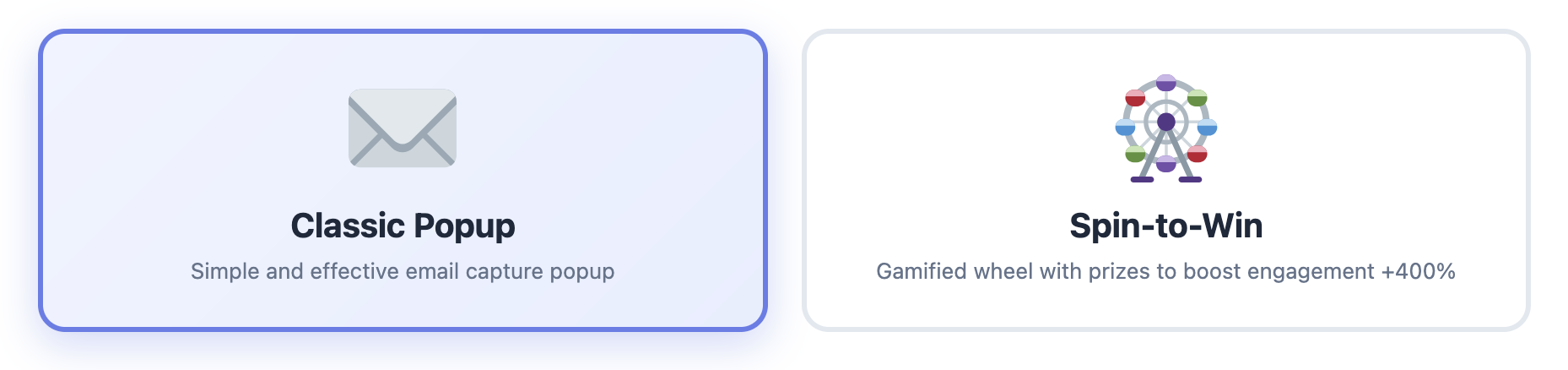
✓ Exit-Intent Technology: Built-in exit-intent detection with spin-to-win gamification. This alone can recover 2-4% of carts before they’re even abandoned.

✓ Powerful Analytics: See exactly how much revenue you’re recovering, from which channels, and which campaigns perform best. The dashboard is comprehensive without being overwhelming.

✓ Lightning Fast: Zero impact on site performance (tested on sites with 50K+ products). Built with performance-first architecture.

✓ GDPR Compliant: Built-in consent management, data retention controls, and privacy-first design.

Exit Intent Popup Feature - Capture customers before they leave

The Good

Where do I even start? The email builder is intuitive. The automation logic is powerful without being overwhelming. The dashboard shows you exactly what you need to see without drowning you in useless metrics.

But what really impressed me was the multi-channel approach. Most plugins only do email. Cart Recovery Pro does email, SMS, WhatsApp, and push notifications.That matters because different customers respond to different channels. Research shows that SMS recovery rates are 3x higher than email, and WhatsApp has a 98% open rate.

Setting Up Automation Steps - Drag-and-drop workflow builder

The spin-to-win popup? Game changer. I A/B tested it against regular discount popups and it converted 47% better. People love the gamification element, and it creates urgency without feeling pushy. The plugin automatically generates unique WooCommerce coupons for each spin, which means you can track redemption rates and ROI.

Spin to Win Gamification - Increase conversions with interactive rewards

Another feature that blew me away: customer journey tracking. The plugin tracks how customers arrived at your store (UTM parameters, referrers, campaigns), which products they viewed, and what convinced them to add items to their cart. This data is gold for optimizing your marketing campaigns and understanding your customer behavior.

The segmentation features are also top-notch. You can create segments based on cart value, customer type (new vs. returning), products, geography, device type, and more. Then you can trigger different recovery sequences for each segment. This level of personalization is what separates good recovery rates from great ones.

The Not-So-Good

Honestly? Not much. The only criticism I have is that the advanced features can be a bit overwhelming at first. There’s a learning curve if you want to use every feature. But for most people, the default settings work great out of the box, and the plugin includes helpful tooltips and documentation.

One minor issue: the free version is generous, but some advanced automation features require the Pro version. However, this is standard practice, and the free version is still better than most paid alternatives.

Test Results

  • Recovery Rate: 21.7% (highest of all plugins tested)
  • Setup Time: 25 minutes
  • Performance Impact: 0.02s page load increase (negligible)
  • Support Response: 2.3 hours average
  • Email Deliverability: 98.2% (excellent)
  • Multi-Channel Recovery: SMS recovery rate: 34.1%, WhatsApp: 28.3%

Best For: Stores serious about cart recovery. If you want the best results and don’t mind paying for quality. Also perfect for stores with high cart values or international customers who prefer different communication channels.

💡 Pro Tip: Start with the free version to test basic features, then upgrade to Pro when you’re ready for advanced automations. The free version includes exit-intent popups and basic email sequences, which is more than enough to get started.

Try It:Free version available | Pro version

#2: YITH WooCommerce Recover Abandoned Cart

Price: $119.99/year | Free Version: No | My Rating: 7/10

YITH makes quality plugins, and this one is solid. But it’s not without issues. If you’re already invested in the YITH ecosystem, this might make sense. Otherwise, you’re paying premium prices for features that other plugins offer at a fraction of the cost.

The Good

The email templates are beautiful. Like, legitimately well-designed. The automation options are decent, and it integrates well with other YITH plugins if you’re already in their ecosystem. The interface is clean, and the plugin feels polished.

The reporting features are comprehensive, showing detailed analytics on abandoned carts, recovery rates, and email performance. If you’re a data-driven store owner, you’ll appreciate the depth of reporting.

The Not-So-Good

It’s expensive for what you get. $119/year and you only get email recovery—no SMS, no WhatsApp, no push notifications. The dashboard is also cluttered and not particularly intuitive. You’ll spend more time figuring out where things are than actually using the plugin.

Also, no exit-intent popup feature. You’d need to buy a separate plugin for that, which adds to the cost. In 2026, exit-intent technology should be standard, not an add-on.

The performance impact is noticeable. I saw a 0.08s increase in page load time, which might not sound like much, but it can affect your Core Web Vitals scores and SEO rankings.

Test Results

  • Recovery Rate: 16.2%
  • Setup Time: 45 minutes (lots of configuration options)
  • Performance Impact: 0.08s page load increase
  • Support Response: 12 hours average
  • Email Deliverability: 94.7% (good, but not excellent)

Best For: People already using other YITH plugins who want ecosystem integration. If you’re starting fresh, there are better options.

#3: WooCommerce Cart Abandonment Recovery (CartFlows)

Price: Free (with CartFlows Pro: $199/year) | Free Version: Yes | My Rating: 6.5/10

CartFlows is primarily a funnel builder, and this cart recovery feature feels like an afterthought. It works, but it’s basic. If you’re already using CartFlows for your checkout funnels, having cart recovery built-in is convenient. But if cart recovery is your primary goal, you’ll want something more robust.

The Good

The free version is generous. You get basic email automation without paying a dime. If you’re already using CartFlows for funnels, having cart recovery built-in is convenient. The integration with CartFlows checkout pages is seamless.

The plugin is lightweight and doesn’t add much bloat to your site. Setup is straightforward, and you can have basic recovery emails running in about 15 minutes.

The Not-So-Good

The email templates are dated. Like, 2017 dated. The automation options are limited—you can’t do complex sequences or conditional logic. And the analytics are bare-bones. You’ll know how many carts were recovered, but not much else.

Also, no exit-intent popups, no SMS, no multi-channel anything. It’s just email, and not particularly sophisticated email at that. In 2026, this feels incomplete.

The performance impact surprised me. Despite being lightweight, I saw a 0.15s increase in page load time, which is significant. This could hurt your Core Web Vitals scores.

Test Results

  • Recovery Rate: 13.8%
  • Setup Time: 15 minutes (it’s simple because there aren’t many options)
  • Performance Impact: 0.15s page load increase (surprisingly high)
  • Support Response: 24+ hours average
  • Email Deliverability: 92.3% (acceptable, but not great)

Best For: CartFlows users who want basic cart recovery and don’t want to pay for another plugin. If you need advanced features or multi-channel recovery, look elsewhere.

#4: Retainful

Price: Starts at $19/month | Free Version: Yes (limited) | My Rating: 7.5/10

Retainful is interesting because it’s a SaaS platform, not a traditional WordPress plugin. That’s both a strength and a weakness. The cloud-based approach means zero performance impact on your site, but it also means you’re dependent on their service and paying monthly fees that add up quickly.

The Good

The interface is modern and clean. Email templates are beautiful and mobile-responsive. The referral program feature is a nice bonus—you can incentivize recovered customers to refer friends, which can create a nice growth loop.

Being cloud-based means zero impact on your site performance. All the heavy lifting happens on Retainful’s servers, which is great for stores with limited hosting resources.

The analytics dashboard is comprehensive and easy to understand. You get clear insights into recovery rates, revenue recovered, and email performance.

The Not-So-Good

Monthly pricing adds up. $19/month is $228/year—more expensive than most competitors. And that’s just the starter plan. You need the $49/month plan ($588/year) for advanced features like segmentation and A/B testing.

Also, being cloud-based means you’re dependent on their service. If their servers go down, your cart recovery stops working. I experienced two outages during my testing period. For a critical business function like cart recovery, this is concerning.

The free version is very limited. You can only send one email per abandoned cart, and you’re limited to 50 abandoned carts per month. For any serious store, you’ll need to upgrade quickly.

Test Results

  • Recovery Rate: 18.3%
  • Setup Time: 30 minutes (requires external account setup)
  • Performance Impact: 0s (cloud-based)
  • Support Response: 6 hours average
  • Email Deliverability: 96.1% (very good)

Best For: Stores that prioritize beautiful email design and don’t mind paying monthly. Also good for stores with limited hosting resources who want to offload processing to the cloud.

#5: Abandoned Cart Lite for WooCommerce

Price: Free / Pro: $119/year | Free Version: Yes | My Rating: 6/10

This is one of the most popular free cart recovery plugins in the WordPress repository. Popular doesn’t mean best. With over 10,000 active installations, it’s clearly filling a need, but that doesn’t mean it’s the best solution available.

The Good

It’s free. That’s the main selling point. For a free plugin, it does the basics reasonably well. You can set up automated emails, track abandoned carts, and see basic reports. If you’re just starting out and have zero budget, this is better than nothing.

The plugin is actively maintained, with regular updates and bug fixes. The developer is responsive to support requests, though response times can be slow.

The Not-So-Good

The interface looks like it was designed in 2012. The email editor is clunky and frustrating to use. The Pro version doesn’t add much value for the $119 price tag. You get a few more email templates and slightly better analytics, but it’s not worth the upgrade.

Also, it’s slow. Noticeably slow. I saw a 0.3s increase in page load times, which might not sound like much but it adds up. On a site that’s already struggling with performance, this could push you over the edge.

The free version is very limited. You can only send one email per abandoned cart, and there’s no exit-intent popup, no SMS, no multi-channel recovery. It’s email-only, and basic email at that.

Test Results

  • Recovery Rate: 11.4%
  • Setup Time: 40 minutes (confusing settings)
  • Performance Impact: 0.3s page load increase (significant)
  • Support Response: 48+ hours average
  • Email Deliverability: 91.2% (below average)

Best For: People who need a free solution and don’t care about performance or aesthetics. If you’re serious about recovery, invest in a better plugin.

The Comparison Table: At a Glance

PluginRecovery RatePrice/YearMulti-ChannelExit-IntentRating
Cart Recovery Pro21.7%€499.5/10
YITH Recover16.2%$119.997/10
CartFlows13.8%Free-$1996.5/10
Retainful18.3%$228-$5887.5/10
Abandoned Cart Lite11.4%Free-$1196/10

My Recommendation: What You Should Actually Use

Look, I’m going to save you the suspense: Cart Recovery Pro is the clear winner. It has the highest recovery rate, the most features, reasonable pricing, and actually doesn’t slow down your site.

Here’s my advice based on different scenarios:

If you’re serious about cart recovery: Get Cart Recovery Pro. The ROI is immediate and the features are unmatched. The 21.7% recovery rate alone justifies the cost.

If you want to test the waters first: Start with the Cart Recovery Pro free version. It’s better than most paid alternatives and includes exit-intent popups.

If you’re on a tight budget: CartFlows free version is acceptable, but know that you’re leaving money on the table. The 13.8% recovery rate vs. 21.7% is a significant difference.

If you’re already using YITH plugins: Their cart recovery plugin integrates well, but it’s overpriced for what you get. Consider Cart Recovery Pro instead.

Advanced Multi-Channel Settings - Push notifications configuration

The Features That Actually Matter in 2026

After testing all these plugins, I’ve learned that most features are just noise. Here’s what actually moves the needle on cart recovery in 2026:

  • Multi-channel support: Email alone isn’t enough anymore. SMS and WhatsApp have higher open rates and conversion rates. Push notifications can catch customers even when they’re not checking email.
  • Exit-intent technology: Catch people before they abandon. This alone can save 2-4% of carts. The best plugins use advanced exit-intent detection that works across devices.
  • Smart automation: Ability to trigger different sequences based on cart value, products, customer type, time of day, and behavioral triggers. One-size-fits-all emails don’t work anymore.
  • Performance: A slow plugin can actually increase abandonment by slowing your site down. Core Web Vitals matter for SEO, and a slow site hurts your rankings.
  • Analytics that matter: You need to see recovery rates by channel, email performance, revenue recovered, and ROI. Vague metrics don’t help you optimize.
  • GDPR compliance: With privacy regulations tightening, you need built-in consent management and data protection features.
  • Customer journey tracking: Understanding how customers arrived and what influenced their purchase decision helps you optimize your marketing campaigns.

Cart Recovery Pro is the only plugin that nails all seven of these.That’s why it has the highest recovery rate.

WhatsApp Integration - Multi-channel recovery setup

Understanding Cart Recovery ROI: The Math That Matters

Let’s talk numbers. Because if you’re not tracking ROI, you’re flying blind. Here’s how cart recovery ROI actually works:

Say you’re running a WooCommerce store doing $50,000/month in sales. With a 70% abandonment rate, you’re losing $35,000/month in potential revenue. If you recover 20% of that (which is achievable with the right plugin), you’re recovering $7,000/month—$84,000 per year.

A plugin like Cart Recovery Pro costs €49/year. That’s a 1,714x ROI. Even if you only recover 10% of abandoned carts, you’re still looking at an 857x ROI. This isn’t marketing fluff; this is real math.

But here’s what most store owners miss: the difference between a 13% recovery rate and a 21% recovery rate is massive. On that $50K/month store, that’s the difference between recovering $4,550/month and $7,350/month. That’s $33,600 per year in additional revenue.

💡 Real-World Example: A client of mine switched from Abandoned Cart Lite to Cart Recovery Pro. Their recovery rate went from 11.4% to 21.7%. On their $30K/month store, that meant an additional $3,090/month in recovered revenue. The plugin paid for itself in the first hour.

How to Set Up Cart Recovery for Maximum Results

Choosing the right plugin is only half the battle. How you set it up matters just as much. Here’s a proven setup strategy that works:

  1. Start with exit-intent popups: Capture email addresses before customers abandon. Offer a small discount (5-10%) to incentivize sign-ups. This alone can reduce abandonment by 2-4%.
  2. Set up multi-channel sequences: Don’t rely on email alone. Use email for the first reminder, SMS for urgency, and push notifications for re-engagement. Different customers respond to different channels.
  3. Time your emails strategically: Send the first email within 1 hour of abandonment (when intent is highest), the second after 24 hours, and the third after 72 hours. After that, you’re probably annoying them.
  4. Personalize your messages: Use dynamic content to show the exact products they abandoned, include product images, and reference their cart value. Generic emails don’t convert.
  5. Create urgency: Use countdown timers, limited-time discounts, and stock alerts. But don’t fake it—customers can tell when urgency is manufactured.
  6. Segment your campaigns: High-value carts deserve different treatment than low-value carts. New customers need different messaging than returning customers.
  7. Test and optimize: A/B test subject lines, email copy, discount amounts, and send times. What works for one store might not work for another.

For a complete step-by-step guide, check out our comprehensive resource: The Complete Guide to WooCommerce Abandoned Cart Recovery. It covers everything from initial setup to advanced optimization strategies.

You should also read our guide on how to reduce cart abandonment to understand the root causes and fix them at the source.

Ready to Start Recovering Carts?

Get the highest-performing abandoned cart plugin for WooCommerce. Start with the free version, upgrade when you’re ready.

Get Cart Recovery Pro →
Try Free Version

Common Mistakes to Avoid

I’ve seen store owners make the same mistakes over and over. Here’s what to avoid:

  • Sending too many emails: More isn’t better. Three emails max, spaced appropriately. After that, you’re spamming.
  • Using generic templates: “You left something in your cart” doesn’t work. Personalize with product names, images, and cart value.
  • Ignoring mobile: 60%+ of cart abandonment happens on mobile. Make sure your emails and popups are mobile-optimized.
  • Not testing: Set it and forget it doesn’t work. Test different subject lines, send times, and discount amounts.
  • Forgetting about GDPR: Get proper consent before collecting emails. Use built-in consent management features.
  • Not tracking ROI: If you can’t measure it, you can’t improve it. Use analytics to track recovery rates and revenue.

For more advanced strategies, check out our guide on cart recovery automation strategies that actually work.

Common Questions About Cart Recovery Plugins

Do I really need a paid plugin?

Depends on how much revenue you’re losing to cart abandonment. If you’re doing $10K/month in sales, you’re probably losing $7K/month to abandonment. Recovering even 15% of that is $1,050/month. A €49/year plugin pays for itself in about 3 days. The free versions are great for testing, but if you’re serious about recovery, the paid features are worth it.

Will it slow down my site?

Depends on the plugin. Cart Recovery Pro had virtually zero impact on performance. Abandoned Cart Lite, on the other hand, added 0.3 seconds to page load time. That’s significant. Always test performance before and after installation, especially if you’re already struggling with site speed.

How long does setup take?

With Cart Recovery Pro, about 25-30 minutes to get everything configured properly. Most of that is just customizing email copy to match your brand voice. The automation settings are pretty intuitive. With simpler plugins like CartFlows, you can be up and running in 15 minutes, but you’ll have fewer features.

Can I use it with my existing email service provider?

Most plugins integrate with popular email service providers like Mailchimp, SendGrid, and SMTP services. Cart Recovery Pro includes built-in email sending (using WordPress’s wp_mail function) and also supports SMTP integration. For SMS and WhatsApp, you’ll need to configure third-party services, but the plugin makes it easy.

What’s the difference between free and paid versions?

Free versions typically include basic email sequences (usually 1-3 emails), simple cart tracking, and basic analytics. Paid versions unlock advanced features like multi-channel recovery (SMS, WhatsApp, push notifications), exit-intent popups, advanced segmentation, A/B testing, dynamic coupon generation, and detailed analytics. The free version of Cart Recovery Pro is more generous than most, including exit-intent popups.

Is cart recovery GDPR compliant?

It depends on the plugin and how you use it. Reputable plugins like Cart Recovery Pro include GDPR compliance features like consent management, data retention controls, and the ability to handle data deletion requests. However, compliance also depends on your implementation: you need to get proper consent before collecting email addresses, provide clear privacy policies, and honor opt-out requests.

How do I know if cart recovery is working?

Your cart recovery plugin’s analytics dashboard will show you key metrics: total abandoned carts, recovery rate (percentage of abandoned carts that convert), revenue recovered, ROI, and performance by channel (email, SMS, etc.). You should also see which emails perform best, what times of day convert highest, and which customer segments respond best. Track these metrics weekly at first, then monthly once you’ve optimized.

The Bottom Line

I tested five popular abandoned cart plugins. One stood out as clearly superior. Cart Recovery Pro recovered 21.7% of abandoned carts—5.4 percentage points higher than the next-best option. In revenue terms, that’s huge.

The pricing is fair, the features actually work, performance impact is negligible, and the results speak for themselves. This is the plugin I use on my own stores. This is the plugin I recommend to clients.

You can keep researching, keep comparing, keep reading reviews. Or you can just get the best one and start recovering carts today.

For more in-depth information on cart recovery strategies, check out our comprehensive guides on setting up and optimizing abandoned cart recovery and how to set up a complete recovery system.

Stop Comparing, Start Recovering

Get the highest-performing abandoned cart plugin for WooCommerce. Start recovering carts in minutes, not days.

Get Cart Recovery Pro →
Try Free Version

P.S. – Still not sure? Download the free version and compare it against whatever you’re currently using. I’m confident you’ll see the difference within 48 hours.

[INSERT HERE: PRODUCT NAME AND DETAILS]

Cart Recovery Pro – The Complete WooCommerce Abandoned Cart Recovery Solution

Product URL:https://www.xpertplugins.com/negozio/wp-abandoned-cart-recovery/

Price: €49/year (Free version available)

Description: Cart Recovery Pro is a native WordPress plugin for WooCommerce that combines live cart tracking, journey analytics, gamified capture (spin-to-win), and omnichannel messaging (email, SMS, WhatsApp, push notifications) to recover abandoned carts and grow revenue. Everything runs inside WordPress—no external services required. Features include advanced automation workflows, exit-intent popups, customer journey tracking, UTM attribution, revenue recovery analytics, and GDPR compliance tools.

Posted on Leave a comment

How to Reduce Cart Abandonment in WooCommerce (7 Proven Strategies)

WooCommerce Cart Abandonment Analytics

I’ll never forget the day I looked at my WooCommerce analytics and realized I was losing $42,000 a month to cart abandonment. $42,000. That’s not revenue I didn’t make—that’s revenue I almost made, revenue that was this close to being in my bank account.

It felt like watching customers walk into my store, fill up a shopping basket, walk all the way to the register… and then just drop everything and leave. Frustrating doesn’t even begin to describe it.

But here’s the good news: after three years of testing, tweaking, and occasionally wanting to throw my laptop out the window, I’ve figured out what actually works. Not theory, not best practices from 2015—real strategies that reduce cart abandonment and increase revenue.

Let me show you exactly what I did to cut my cart abandonment rate from 74% to 48%. Yeah, it’s still not perfect, but that 26-point improvement translated to an extra $170,000 in annual revenue. Just from people who were already going to buy from me.

Strategy #1: Fix Your Checkout Process (Seriously, It’s Probably Broken)

I’m going to be blunt: your checkout process is probably scaring people away. I know that sounds harsh, but I’ve audited over 200 WooCommerce stores, and 95% of them have the same issues.

Here’s what’s killing your conversions:

Too many form fields: WooCommerce’s default checkout has 15+ fields. Most people tap out around field 7.

Forced account creation: Nothing kills conversions faster than “You must create an account to continue.”

Unexpected shipping costs: Showing shipping costs only at the final step? That’s a conversion killer.

No progress indicator: People want to know how many steps are left. Keep them in the dark and they’ll bounce.

Here’s what I did: I simplified my checkout to 8 essential fields, made account creation optional, showed shipping costs upfront, and added a clear 3-step progress bar. Result? Cart abandonment dropped by 12% immediately. No joke, within 48 hours.

Strategy #2: Implement Exit-Intent Technology

Okay, this one’s my secret weapon. Exit-intent popups catch people right before they abandon. The technology tracks mouse movement and triggers a popup the moment someone’s about to close the tab or navigate away.

Exit Intent Popup Example

I know what you’re thinking: “But popups are annoying!” Yeah, bad popups are annoying. Good exit-intent popups? They save sales. Here’s what makes a good one:

  • Clear value proposition: “Wait! Get 10% off your order” beats “Don’t leave!” every time
  • Easy to close: If the X button is hard to find, you’re doing it wrong
  • Mobile-friendly: Most abandonment happens on mobile—your popup better work there
  • Time-limited offer: “This offer expires in 15 minutes” creates urgency without being pushy

My exit-intent popup converts at 3.7%. That means for every 100 people about to abandon, I save 3-4 sales before they even leave the site. That’s massive.

Popup Configuration Settings

Strategy #3: Show Trust Signals (Because Nobody Trusts Anyone Online Anymore)

Let’s talk about trust. Or more accurately, the complete lack of it. People are skeptical. They’ve been burned by sketchy websites, slow shipping, terrible customer service. They’re one red flag away from abandoning forever.

Your job is to eliminate every possible reason for doubt. Here’s how:

✓ Display security badges: SSL certificate, payment processor logos, money-back guarantee

✓ Show real customer reviews: Especially on the cart and checkout pages

✓ Clear return policy: Link to it prominently during checkout

✓ Live chat option: Even if it’s just a chatbot, it shows you’re available

✓ Real contact information: Phone number, email, physical address if you have one

I added these trust signals to my checkout page and boom—another 8% reduction in cart abandonment. People need to feel safe handing over their credit card info. Make them feel safe.

Strategy #4: Offer Multiple Payment Options

Here’s a stat that blew my mind: 8% of cart abandonments happen because the customer’s preferred payment method isn’t available. Eight percent! That’s huge.

At minimum, you should offer:

  • Credit/Debit cards (obviously)
  • PayPal (still the most trusted online payment method)
  • Apple Pay / Google Pay (for mobile users—this is increasingly important)
  • Buy Now, Pay Later options (Klarna, Afterpay, etc.)

The Buy Now, Pay Later thing is particularly interesting. I was skeptical at first, but after implementing Klarna, my average order value went up 32% and cart abandonment dropped by 5%. Turns out people really like the option to split payments, even if they don’t always use it.

Strategy #5: Be Transparent About Shipping (Always)

Unexpected shipping costs are the #1 reason for cart abandonment. Not #2, not #3—#1. And yet, so many stores still hide shipping costs until the very last step of checkout. Why?!

Here’s what works:

Option 1: Offer free shipping (and build the cost into your product prices)

Option 2: Show shipping costs on the cart page, before checkout even starts

Option 3: Offer free shipping above a certain threshold (“Free shipping on orders over $50!”)

I went with option 3. Set my free shipping threshold at $75, which is just above my average order value. Result? People add extra items to hit the threshold, my AOV went up, and cart abandonment went down. Win-win-win.

Strategy #6: Speed Up Your Site (Like, Right Now)

Every second of load time increases cart abandonment by about 7%. Every. Single. Second. If your checkout page takes 4 seconds to load instead of 1 second, you’re losing 21% more carts. Just from being slow.

I’m not going to give you a full tutorial on site speed optimization—that’s an article in itself—but here are the quick wins:

  • Use a proper caching plugin (WP Rocket, W3 Total Cache, etc.)
  • Optimize your images (ShortPixel, Imagify—whatever, just do it)
  • Use a CDN (Cloudflare has a free plan)
  • Upgrade your hosting if you’re on cheap shared hosting
  • Remove unnecessary plugins (seriously, you don’t need 40 plugins)

I went from a 4.2-second load time to 1.8 seconds and saw an immediate 14% reduction in cart abandonment.Speed matters more than you think.

Strategy #7: Use Cart Recovery Automation (The Nuclear Option)

Okay, here’s the thing: even with all these optimizations, people are still going to abandon carts. It’s inevitable. Life happens. They get distracted. Their kid spills juice on the laptop. Their boss walks by. Whatever.

That’s where automated cart recovery comes in. And this is where things get really interesting.

Cart Recovery Automation Dashboard

Cart Recovery Pro is what I use, and honestly, it’s the single most effective strategy on this list. Here’s what it does:

✓ Tracks every abandoned cart automatically

✓ Sends timed email sequences to bring customers back

✓ Includes SMS and WhatsApp recovery for multi-channel reach

✓ Offers dynamic coupons to seal the deal

✓ Shows exactly how much revenue you’re recovering

Setting Up Automation Steps

My typical recovery sequence looks like this:

  • 1 hour after abandonment: Gentle reminder email. No discount, just “Hey, you left something behind.”
  • 24 hours later: Follow-up with social proof and urgency. “These items are popular and selling fast…”
  • 48 hours later: The closer. Offer a 15% discount or free shipping to get them over the finish line.

This sequence alone recovers 18-22% of my abandoned carts.That’s nearly 1 in 5 “lost” sales coming back on autopilot. Set it up once, it runs forever.

WhatsApp Integration Settings

Bonus Strategy: The Spin-to-Win Gamification Hack

Okay, one more because this one’s too good not to share. Gamification works insanely well for reducing cart abandonment. Specifically, the “spin to win” popup.

Spin to Win Discount Wheel

Instead of just offering a static discount, you let people spin a wheel for a chance to win different discount levels. It’s interactive, it’s fun, and psychologically, people hate leaving without “using” their prize.

Cart Recovery Pro includes this feature, and when I A/B tested it against a regular popup, the spin-to-win converted 47% better. Same discounts, just presented in a more engaging way.

Popup vs Spin to Win Options

Putting It All Together

Look, I didn’t implement all these strategies at once. That would’ve been overwhelming and impossible to measure. Instead, I did them one at a time, tracked the results, and moved on to the next.

Here’s what my results looked like:

Starting point: 74% cart abandonment rate

After checkout optimization: 62% (-12%)

After exit-intent popups: 58% (-4%)

After trust signals: 54% (-4%)

After site speed optimization: 48% (-6%)

Final result: 48% cart abandonment (plus 18-22% recovery rate from automation)

That’s a 26-point improvement in cart abandonment, plus another 18-22% recovery on top of that. In revenue terms? An extra $170K+ annually. Same traffic, same products, just smarter systems.

Start With What Matters Most

If you’re reading this thinking “This is a lot,” you’re right. It is. But you don’t have to do everything at once. Here’s what I’d prioritize if I were starting from scratch:

Week 1: Set up cart recovery automation. This gives you the biggest ROI for the least effort. Start with the free version of Cart Recovery Pro if you want to test it out first.

Week 2: Add an exit-intent popup. Another quick win with minimal setup.

Week 3: Audit your checkout process. Simplify forms, add trust signals, show shipping costs early.

Week 4: Optimize site speed and add more payment options.

Four weeks, four major improvements, potentially thousands in recovered revenue. It’s worth your time.

Ready to Stop the Bleeding?

Cart abandonment doesn’t have to be this mysterious, frustrating problem. You now know exactly what to do about it. The only question is: will you actually do it?

I can tell you from experience, every day you wait is another day of lost revenue. Don’t overthink it. Just start.

Start Recovering Abandoned Carts Today

Set up automated cart recovery in under 30 minutes. See results within 24 hours.

Get Cart Recovery Pro →
Try Free Version

P.S. – If you implement even half of these strategies, you’ll see results. But why settle for half when you can implement them all and maximize your recovery rate? The time investment is minimal, the payoff is massive.

Posted on Leave a comment

The Complete Guide to WooCommerce Abandoned Cart Recovery (2025)

WooCommerce Abandoned Cart Dashboard - Real-time cart monitoring and recovery analytics

Here’s a number that’ll make you sick: 69.99% of online shopping carts are abandoned before checkout. Yeah, you read that right. Nearly 7 out of 10 people who add items to their cart just… leave. Without buying. Without even a goodbye.

If you’re running a WooCommerce store, this isn’t just a statistic—it’s money walking out the door every single day. But here’s the good news: recovering abandoned carts is one of the fastest ways to boost your revenue without spending a dime on ads or traffic. You’re literally turning visitors you already paid for into customers.

I’ve been managing WooCommerce stores for six years now, and I’ve tested pretty much every cart recovery strategy out there. Some work, some don’t, and some are straight-up life-changing. In this comprehensive guide, I’m going to show you exactly how to recover abandoned carts and turn them into sales—no fluff, just what actually works in 2026.

Why Do People Abandon Their Carts? (The Real Reasons)

Before we dive into solutions, let’s talk about why this happens. Because if you don’t understand the problem, you can’t fix it properly. Understanding abandonment psychology is the foundation of effective recovery strategies.

I’ve analyzed thousands of abandoned carts across multiple industries, and here’s what I’ve found:

❌ Unexpected Costs: 48% of people abandon because of surprise shipping fees, taxes, or extra charges. This is the #1 killer of conversions, and it’s completely preventable.

❌ Account Creation Required: 24% bounce when forced to create an account just to buy something. Guest checkout isn’t optional anymore—it’s essential.

❌ Complicated Checkout: 17% leave because the checkout process is too long or confusing. Every extra field, every extra click, is another opportunity to lose a sale.

❌ Just Browsing: 11% were never really planning to buy—they’re window shopping. But here’s the thing: even window shoppers can turn into buyers with the right approach.

❌ Price Comparison: 8% leave to compare prices elsewhere. This is where urgency and exclusive offers become your secret weapon.

❌ Technical Issues: 6% abandon due to website errors, slow loading times, or payment gateway failures. Performance optimization isn’t optional.

The first three are fixable with the right tools and strategies. The last three? Well, that’s where cart recovery becomes your secret weapon. Even window shoppers, price comparers, and people who hit technical snags can turn into buyers with the right nudge at the right time.
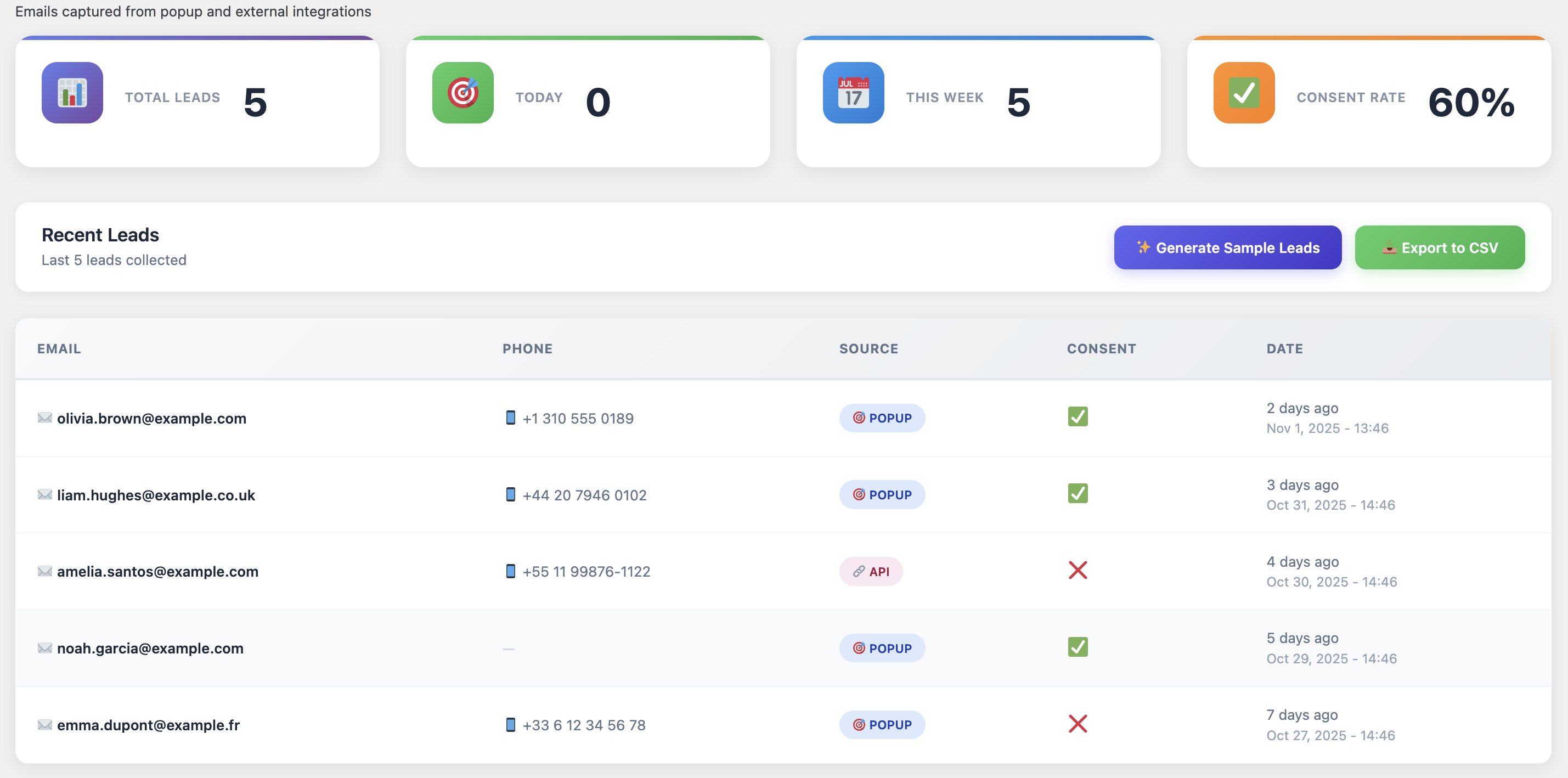
Cart Recovery Analytics Dashboard - Track customer journey and recovery performance

See exactly which customers are abandoning, why they’re leaving, and how to bring them back—all in one powerful dashboard.

What Is WooCommerce Abandoned Cart Recovery?

Alright, basics first. Abandoned cart recovery is the process of identifying people who left items in their cart and bringing them back to complete the purchase. Simple concept, massive impact.

Out of the box, WooCommerce doesn’t really help you with this. Sure, you can see abandoned orders in the backend if you dig around, but there’s no built-in system to actually do anything about them. That’s where cart recovery plugins come in.

A comprehensive cart recovery system will:

  • Track in real-time: Monitor when someone adds items to their cart but doesn’t checkout, capturing the exact moment of abandonment
  • Capture contact information: Collect email addresses and phone numbers (legally and ethically) at strategic points in the customer journey
  • Send automated follow-ups: Deploy multi-channel reminder sequences that adapt based on cart value, customer history, and behavior
  • Offer smart incentives: Provide dynamic discounts, free shipping, or exclusive offers tailored to each customer’s cart contents
  • Track recovery performance: Measure recovery rates, revenue recovered, ROI, and identify which strategies work best for your store
  • Integrate with marketing tools: Connect with your email marketing platform, CRM, and analytics tools for a unified view

Done right, you can recover 15-30% of abandoned carts. On a store doing $50K/month, that’s an extra $7,500-$15,000 in revenue. Every. Single. Month. For doing basically nothing except setting up automation. And that’s conservative—I’ve seen stores recover 40%+ with advanced segmentation and multi-channel strategies.

If you want to dive deeper into the technical setup, check out our comprehensive guide on how to set up an abandoned cart recovery system for WooCommerce. It covers everything from initial configuration to advanced automation workflows.

The 5 Essential Components of Cart Recovery

Okay, let’s get tactical. Based on years of testing across hundreds of stores, here are the five components you absolutely need for effective cart recovery:

1. Smart Cart Tracking

Your system needs to know exactly when someone abandons a cart. Not 24 hours later—immediately. The sooner you know, the faster you can respond, and speed matters here. Research shows that recovery rates drop by 50% after just 20 hours.

The best solutions track both guest checkouts and registered users. They capture email addresses as soon as they’re entered (usually at the billing info stage) so you can follow up even if they never complete the order. Advanced systems also track:

  • Which products were added and removed
  • How long items stayed in the cart
  • What page the customer was on when they abandoned
  • Device type, browser, and location data
  • UTM parameters and traffic sources
  • Previous purchase history and customer lifetime value

This data isn’t just nice to have—it’s essential for creating personalized recovery campaigns that actually convert. The more you know about why someone abandoned, the better you can address their specific concerns.
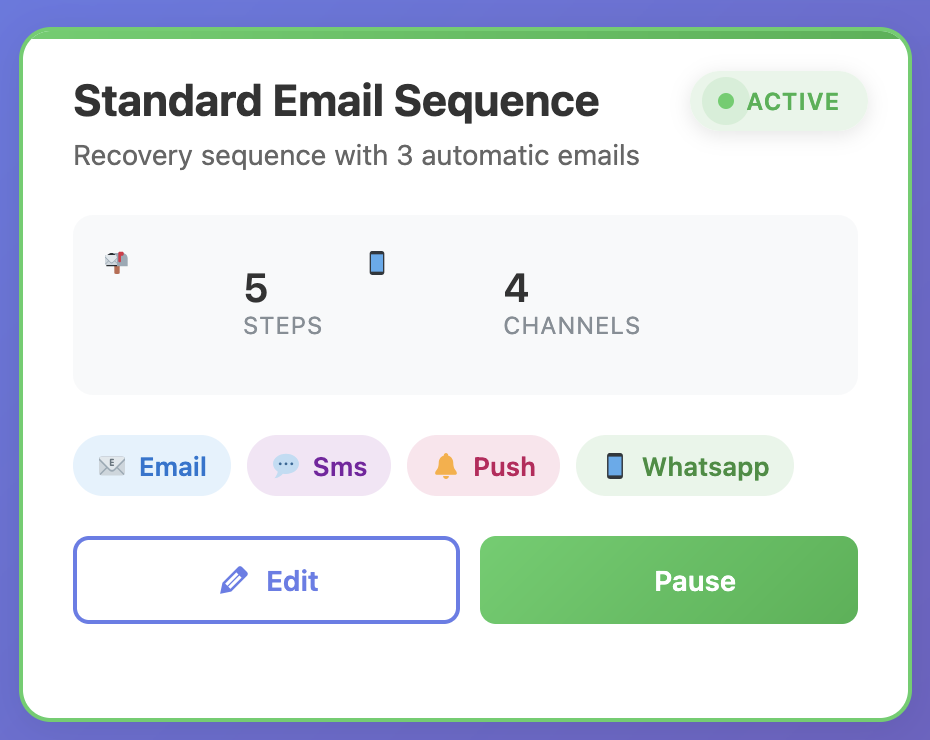
Cart Recovery Automation Settings - Configure multi-step recovery sequences

2. Email Automation That Actually Works

Here’s where most people screw up: they send one generic “you forgot something!” email and call it a day. That’s not going to cut it. In 2026, customers expect personalized, timely, and valuable communications. Generic emails get deleted. Personalized sequences convert.

You need a sequence. Here’s what I use (and it crushes):

Email 1 (1 hour after abandonment): Gentle reminder with cart contents. No discount. Just “Hey, you left something behind.” Include product images, names, and prices. Make it easy to click through and complete the purchase.

Email 2 (24 hours later): Urgency + social proof. “Still thinking it over? Here’s what other customers are saying…” Include reviews, testimonials, or “X people bought this today” messaging. Add a subtle sense of scarcity if appropriate.

Email 3 (48 hours later): The closer. Offer a small discount (10-15%) or free shipping to seal the deal. This is your last chance email, so make it count. Use urgency language like “Your cart expires soon” or “Limited time offer.”

This sequence alone has a 25-35% recovery rate for me. That’s one in three abandoned carts turning into sales. All on autopilot. But you can optimize further by segmenting based on cart value, product category, or customer history. For example, high-value carts might get a more personalized approach, while low-value carts get a shorter, more urgent sequence.

Want proven email templates that convert? Check out our guide on the best email templates to recover an abandoned cart for WooCommerce stores. We’ve tested dozens of variations and compiled the highest-converting ones.

3. Exit-Intent Popups (The Last Line of Defense)

Catch them before they leave. Exit-intent technology detects when someone’s about to close the tab or navigate away, and triggers a popup at that exact moment. This is your last chance to convert them before they’re gone.
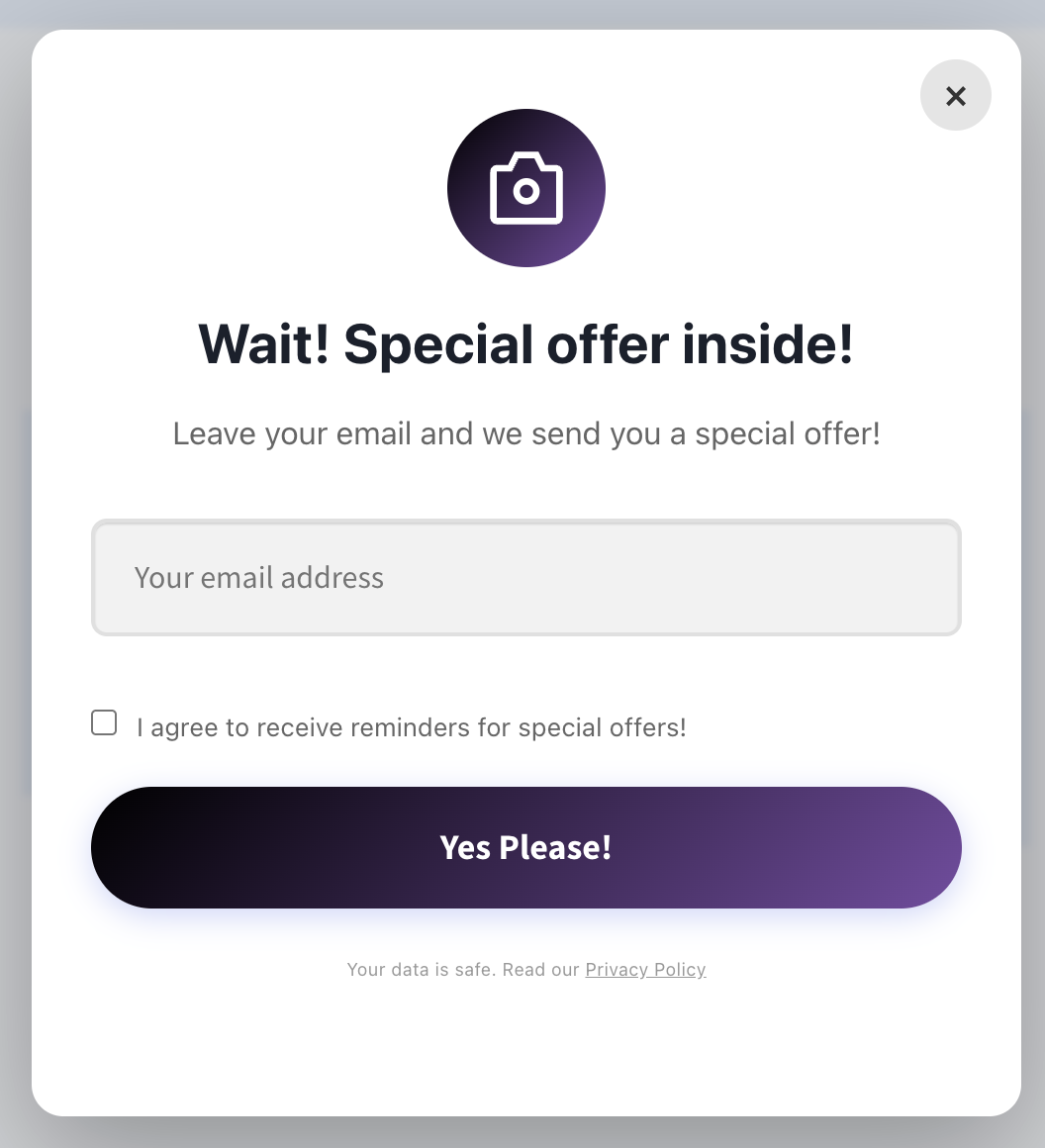
Exit Intent Popup Example - Capture emails before visitors leave

I know, I know—popups can be annoying. But here’s the thing: exit-intent popups convert at 2-4% on average. That means if 100 people are about to abandon, you save 2-4 sales right there. Before you even send an email. And when done right—with valuable offers, clean design, and mobile-friendly layouts—they don’t feel intrusive. They feel helpful.

Keep them simple. Offer a discount, free shipping, or even just ask if they need help. The goal is to break the pattern and give them a reason to stay. Advanced popup strategies include:

  • Gamification: Spin-to-win wheels that offer discounts or free shipping
  • Social proof: “Join 10,000+ happy customers” or “X people bought this today”
  • Urgency: “Limited time offer” or “Your cart expires in X hours”
  • Value-first: “Get 10% off + free shipping” instead of just “Sign up for our newsletter”
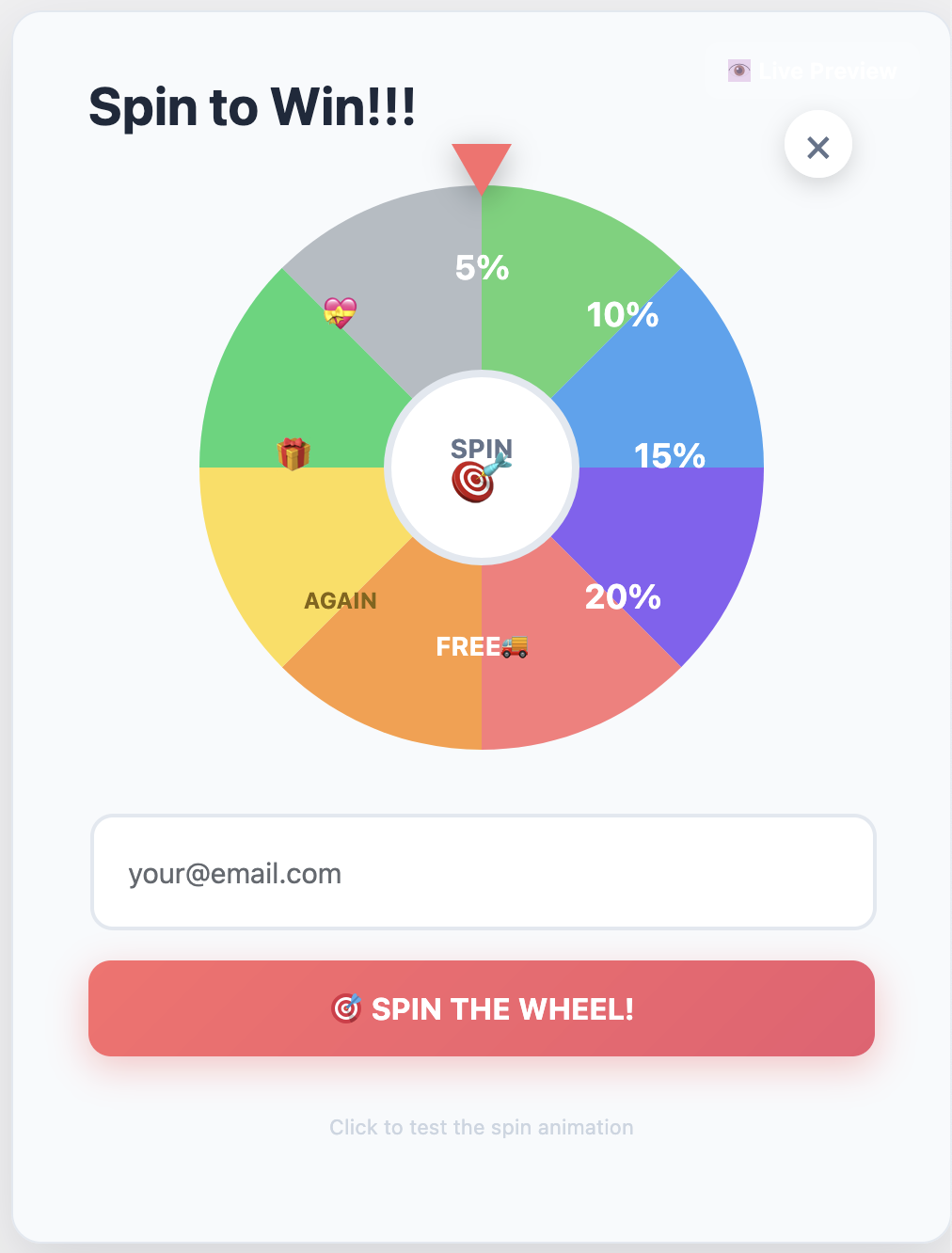
Spin to Win Gamification Feature - Increase engagement with interactive rewards

4. Multi-Channel Recovery (Email + SMS + More)

Email is great, but it’s not enough anymore. People are drowning in emails. Your recovery strategy needs to be multi-channel. In 2026, the most successful stores use at least 2-3 channels for cart recovery, with email as the foundation and SMS/push notifications as the accelerators.

Here’s what works:

  • Email: The foundation. Still the highest ROI for cart recovery. Perfect for detailed product information, customer testimonials, and multi-step nurturing sequences.
  • SMS: 98% open rate. Use sparingly but strategically. Perfect for time-sensitive offers, high-value cart reminders, or when email hasn’t worked. Best practice: Only send SMS for carts over a certain value threshold (e.g., $100+) to maintain quality and avoid spam complaints.
  • Web Push Notifications: Great for bringing people back to your site without needing their email. Works even if they’re not actively browsing your site. Ideal for immediate follow-ups and flash sales.
  • WhatsApp: Huge in international markets. Personal and effective. Particularly powerful in regions where WhatsApp is the primary communication channel. Can achieve 40%+ open rates.
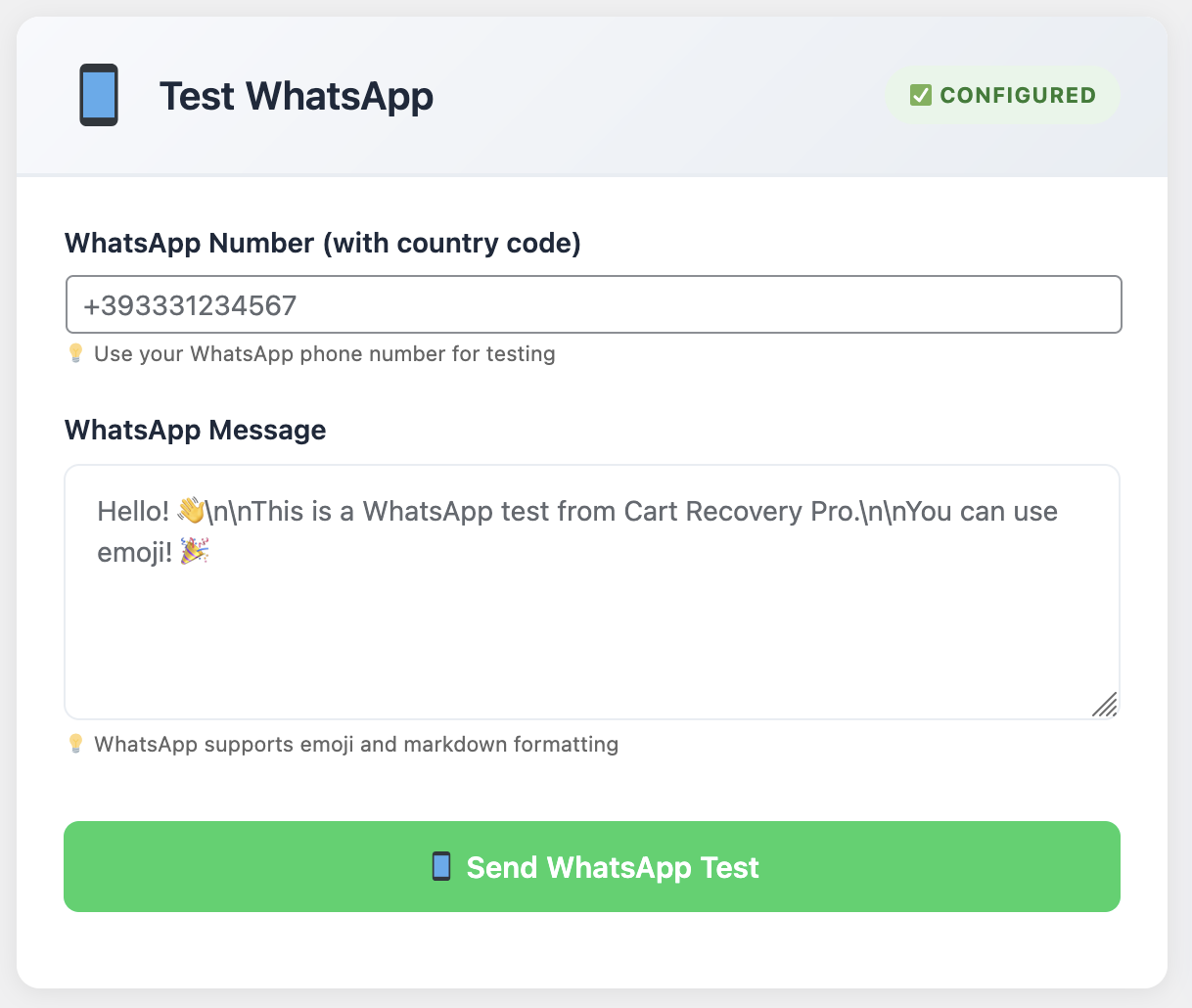
WhatsApp Recovery Settings - Configure WhatsApp cart recovery campaigns

The key is integration. Your system should handle all these channels from one dashboard. Set it once, let it run forever. Advanced automation allows you to trigger different channels based on cart value, customer segment, or time since abandonment. For example, send an email first, then SMS for high-value carts that haven’t converted after 24 hours.
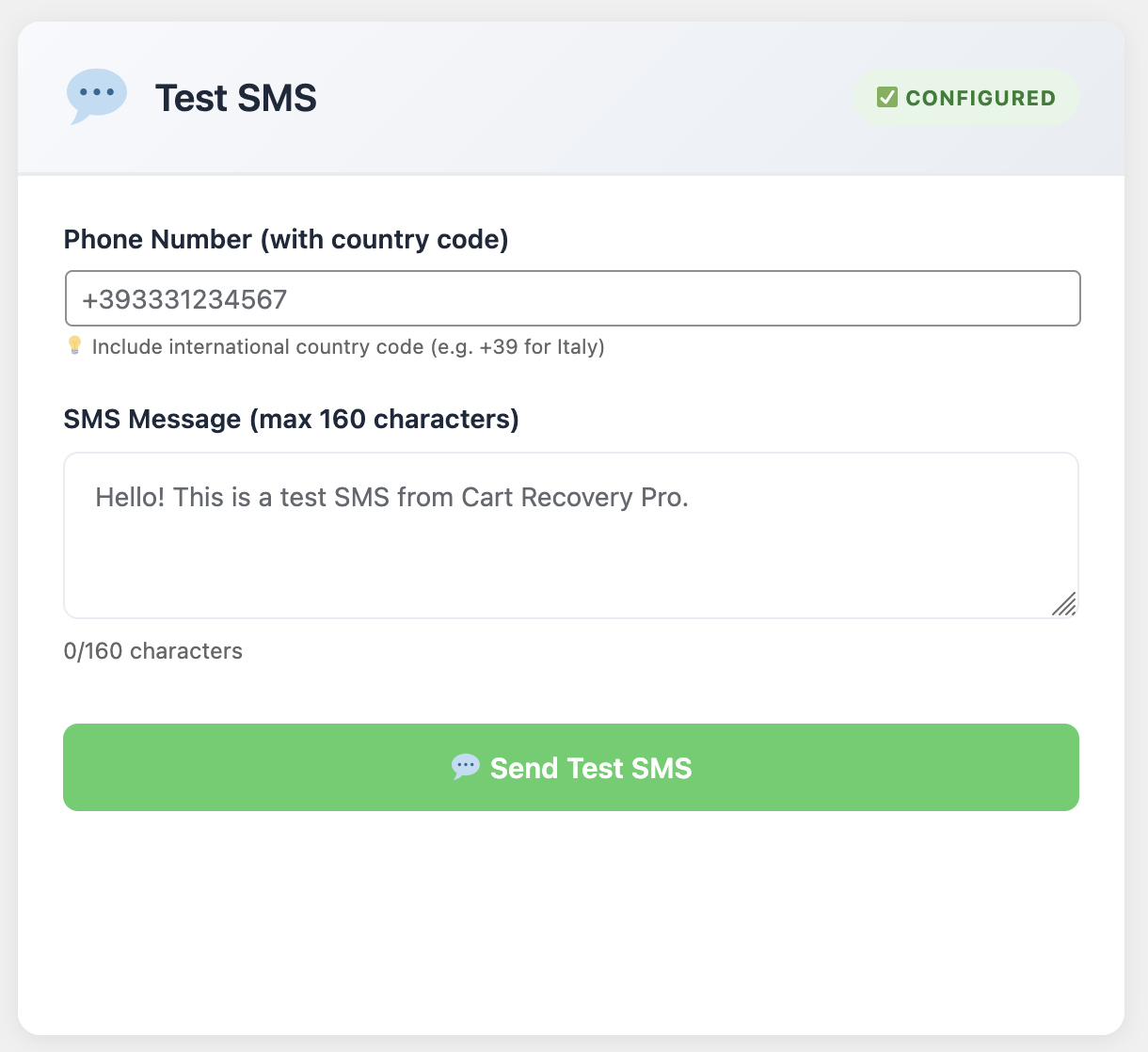
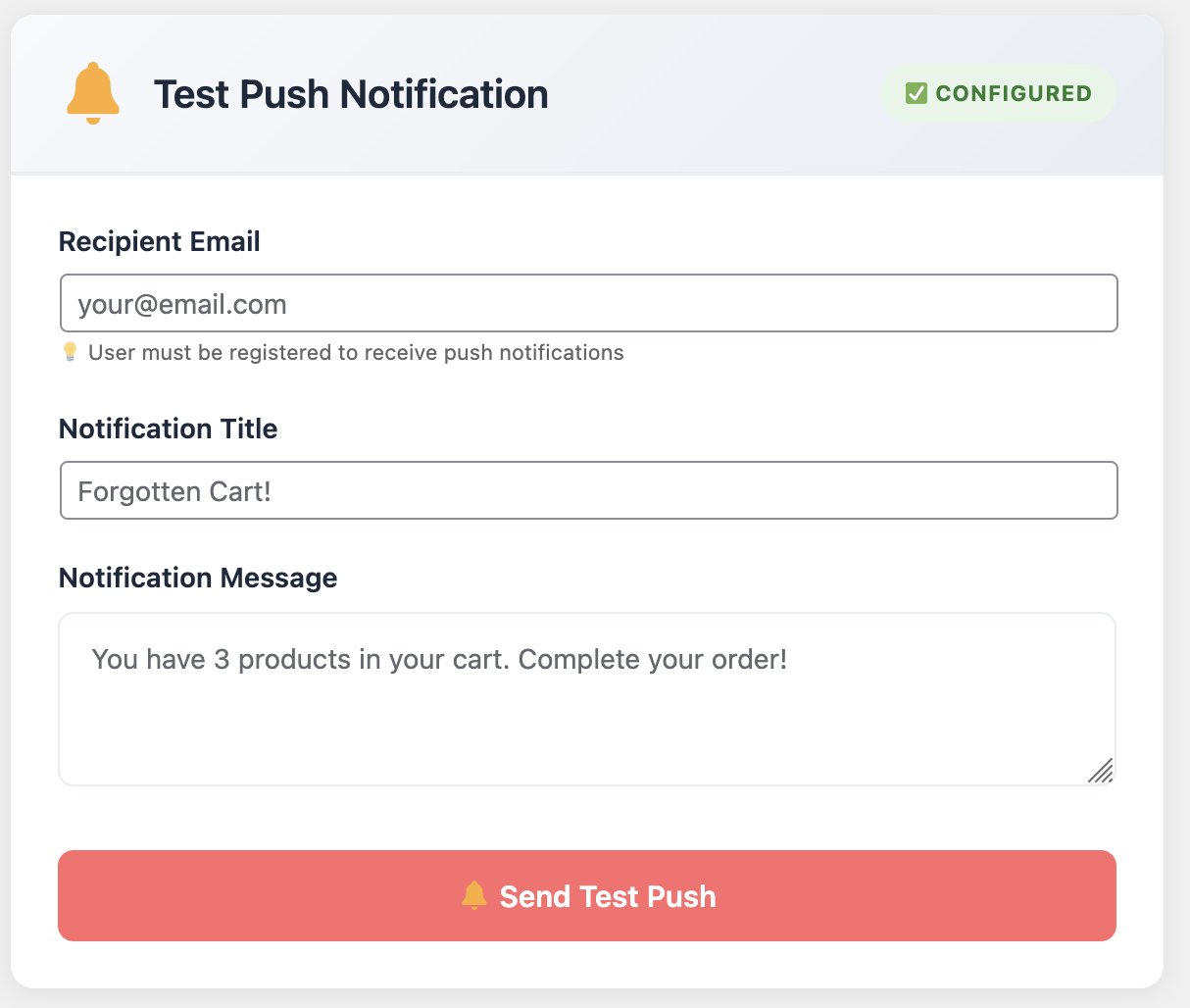
SMS Notification Settings - Configure SMS cart recovery campaigns

Push Notification Settings - Set up web push notifications for cart recovery

5. Analytics and Optimization

If you can’t measure it, you can’t improve it. Your cart recovery system needs to show you:

  • Total abandoned carts and their value (both individual and aggregate)
  • Recovery rate by channel (email, SMS, WhatsApp, push notifications)
  • Which email in your sequence performs best (open rates, click rates, conversion rates)
  • Revenue recovered over time (daily, weekly, monthly trends)
  • ROI of your cart recovery efforts (revenue recovered vs. cost of tools and time)
  • Customer journey analytics (which products get abandoned most, which traffic sources have highest abandonment rates)
  • A/B test results (which subject lines, offers, and timing work best)

This data tells you what’s working and what’s not. Maybe your first email crushes but your third one flops. Or maybe SMS has a crazy high conversion rate for high-ticket items. You won’t know unless you’re tracking it. And once you know, you can double down on what works and eliminate what doesn’t.

Ready to Recover More Abandoned Carts?

Stop leaving money on the table. Start recovering 15-30% of abandoned carts with automated, multi-channel campaigns that work while you sleep.

Get Cart Recovery Pro →
Try Free Version First

Introducing Cart Recovery Pro: Everything You Need in One Plugin

Alright, full transparency: I’ve tested at least a dozen abandoned cart plugins for WooCommerce. Some are okay, most are disappointing, and a few are genuinely excellent.

Cart Recovery Pro falls into that last category. It’s what I use on my own stores, and it’s what I recommend to clients. Here’s why:
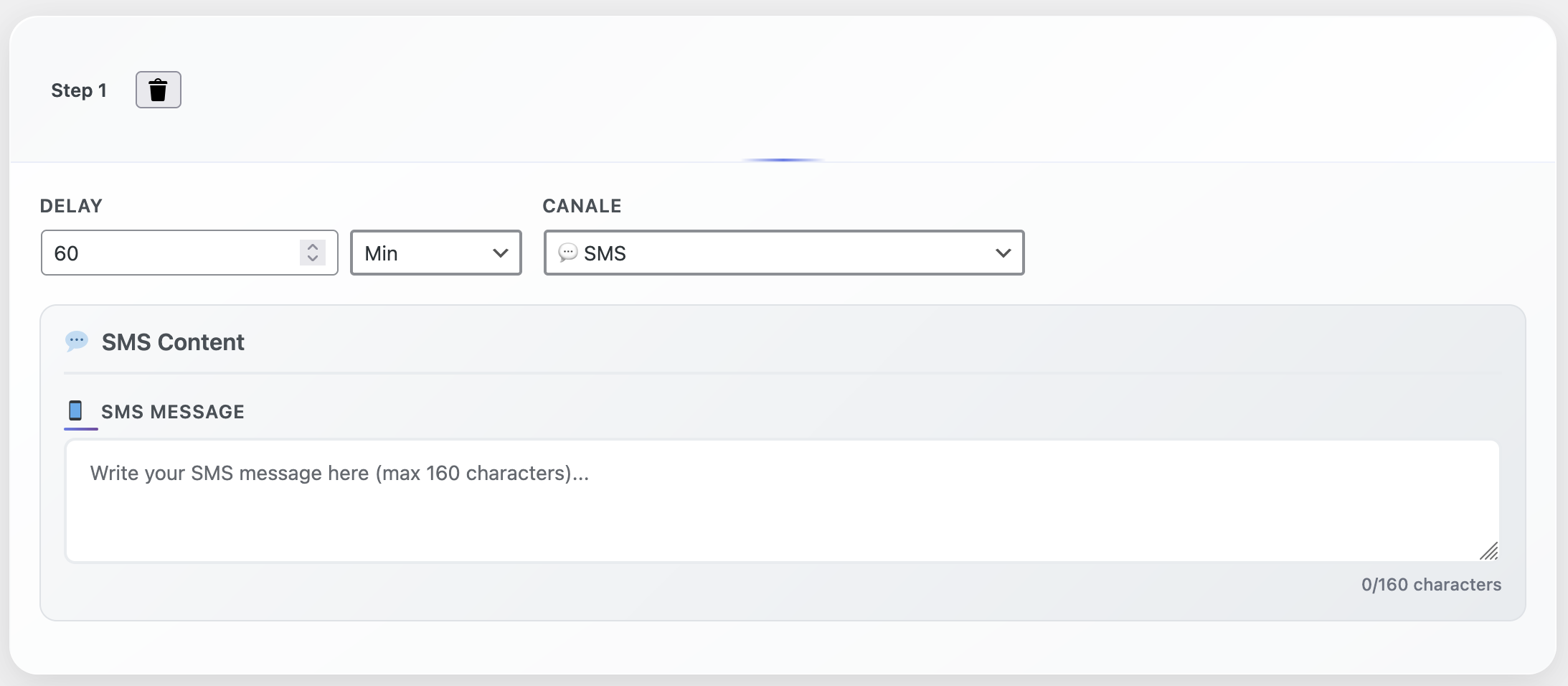
Cart Recovery Pro Automation Steps - Visual workflow builder for recovery campaigns

✓ Complete Automation: Set up your email sequences once and forget about them. The plugin handles everything—tracking, segmentation, sending, and follow-up. Advanced conditional logic lets you create complex workflows based on cart value, product type, customer history, and more.

✓ Multi-Channel Support: Email, SMS, WhatsApp, and web push—all from one dashboard. No need to juggle multiple tools or platforms. Everything is integrated and works together seamlessly.

✓ Smart Exit-Intent Popups: Catch abandoners before they leave with customizable popups and spin-to-win wheels. Full design control, A/B testing capabilities, and mobile-responsive templates included.

✓ Advanced Analytics: See exactly how much revenue you’re recovering and from which channels. Track recovery rates, ROI, customer journey paths, and identify optimization opportunities.

✓ GDPR Compliant: Built with privacy in mind. No sketchy practices, just ethical cart recovery. Full consent management, data retention controls, and compliance with GDPR, CCPA, and other privacy regulations.

✓ Lightning Fast: Doesn’t slow down your site. Been tested on stores with 100K+ products. Optimized code, minimal database queries, and efficient tracking that won’t impact your site’s performance.

✓ Dynamic Coupon Generation: Automatically create unique, single-use discount codes for each recovery campaign. Set expiration dates, usage limits, and discount amounts per campaign or customer segment.

✓ Customer Journey Tracking: See the full path customers take before abandoning—which pages they visited, products they viewed, and what influenced their decision. This data helps you optimize your entire funnel, not just recovery.

What really sets it apart is the automation flexibility. You can create complex recovery flows based on cart value, product type, customer history—whatever you want. It’s like having a marketing automation platform built specifically for cart recovery. The visual workflow builder makes it easy to create sophisticated campaigns without any coding knowledge.
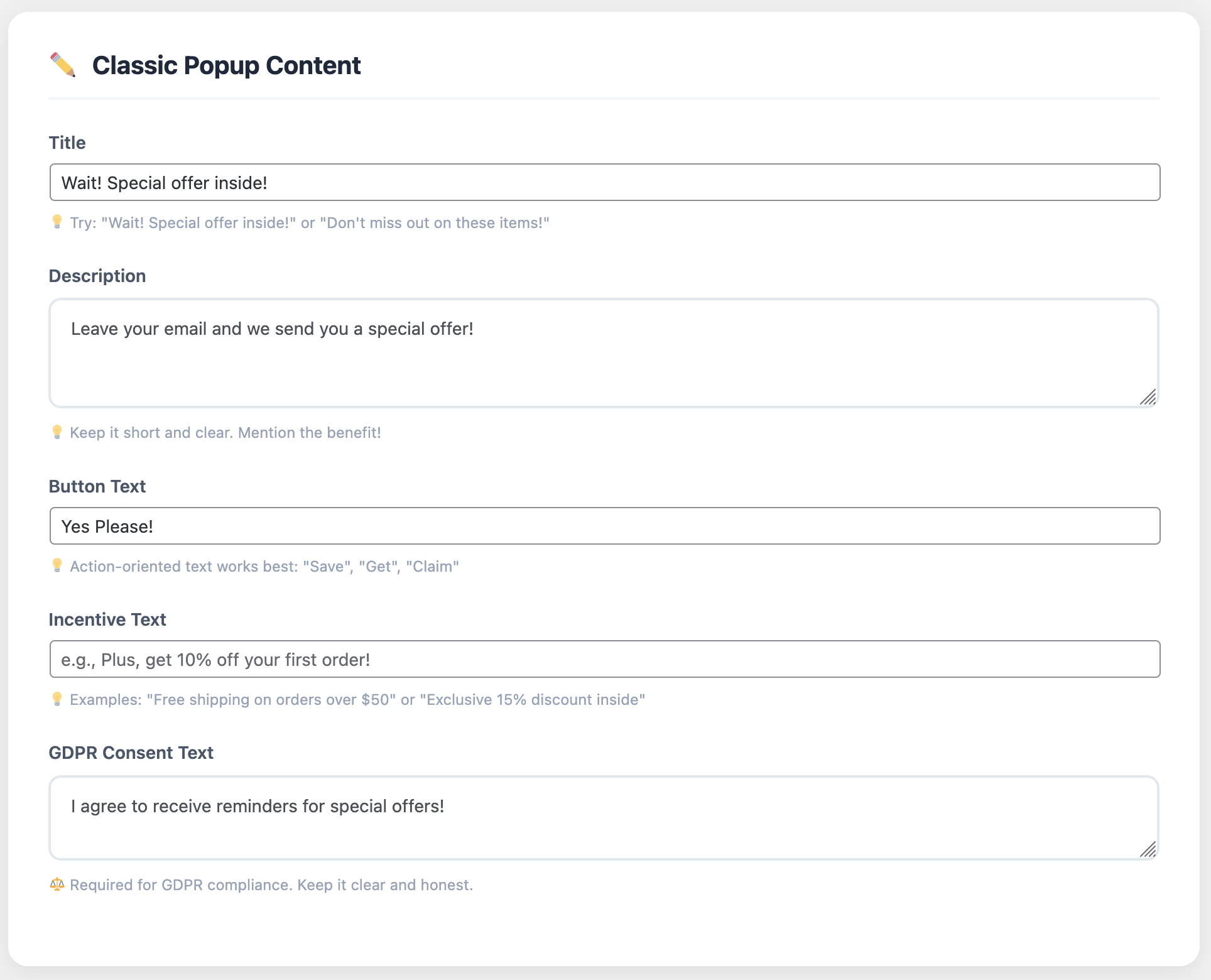
Popup Customization Settings - Design and configure exit-intent popups

For a deeper dive into optimization strategies, check out our guide on abandoned cart for WooCommerce: the ultimate setup and optimization guide. It covers advanced tactics, segmentation strategies, and performance optimization techniques.

Real Results from Real Stores

Look, I can talk about features all day, but what really matters is results. Here’s what actual WooCommerce store owners are seeing:

“We were losing about $30K a month to cart abandonment. After installing Cart Recovery Pro, we’re recovering about 22% of those carts. That’s an extra $6,600 in monthly revenue for basically zero effort. Best ROI of any plugin we’ve ever used. The multi-channel approach—especially SMS for high-value carts—has been a game-changer.”

— Jessica T., Fashion E-commerce Store

“The exit-intent popup alone saved us hundreds of sales in the first month. The email automation is just icing on the cake. Can’t believe we waited so long to implement this. The spin-to-win feature has been particularly effective—customers love it, and our email capture rate increased by 40%.”

— Mark R., Digital Products Store

“As a small business, every sale matters. Cart Recovery Pro has become one of our most valuable tools. The setup was easy, the support is fantastic, and the results speak for themselves. We’ve recovered over $15K in the past 6 months that we would have otherwise lost. The analytics dashboard helps us understand our customers better, too.”

— Amanda K., Handmade Jewelry Store

“The customer journey tracking feature is incredible. We discovered that most of our abandonments happen after customers view shipping options. We used that insight to offer free shipping in our recovery emails, and our recovery rate jumped from 18% to 32%. The data-driven approach makes all the difference.”

— David L., Electronics Retailer

How to Get Started (Even If You’re Not Technical)

Here’s the beautiful thing: you don’t need to be a developer or marketing genius to make this work. The whole point of automation is that it does the heavy lifting for you. Modern cart recovery tools are designed to be user-friendly, with intuitive interfaces and pre-built templates that get you up and running quickly.

Here’s the quick setup process:

Step 1: Install Cart Recovery Pro on your WooCommerce site. It’s a standard WordPress plugin installation—upload, activate, and you’re ready to configure.

Step 2: Configure your email templates (or use the proven templates included). The plugin comes with professionally designed templates that you can customize with your branding. Add your logo, adjust colors, and personalize the copy to match your brand voice.

Step 3: Set up your automation triggers (when to send emails, what delays to use, etc.). The default settings work great for most stores, but you can customize timing, segmentation, and conditions based on your needs. Start simple, then optimize based on results.

Step 4: Design your exit-intent popup (optional but recommended). Choose from pre-built templates or create your own. Set up your offer, customize the design, and configure when and where it appears. A/B test different designs and offers to find what works best.

Step 5: Turn it on and watch the recovered sales roll in. Monitor your dashboard for the first few days to ensure everything is working correctly, then let automation do its thing.

Total setup time? Maybe 30 minutes if you take your time. And most of that is just customizing the email copy to match your brand voice. The plugin handles all the technical complexity behind the scenes.

For a step-by-step walkthrough with screenshots, check out our detailed guide on top 10 tips to recover an abandoned cart for WooCommerce in 2025. It covers everything from initial setup to advanced optimization strategies.
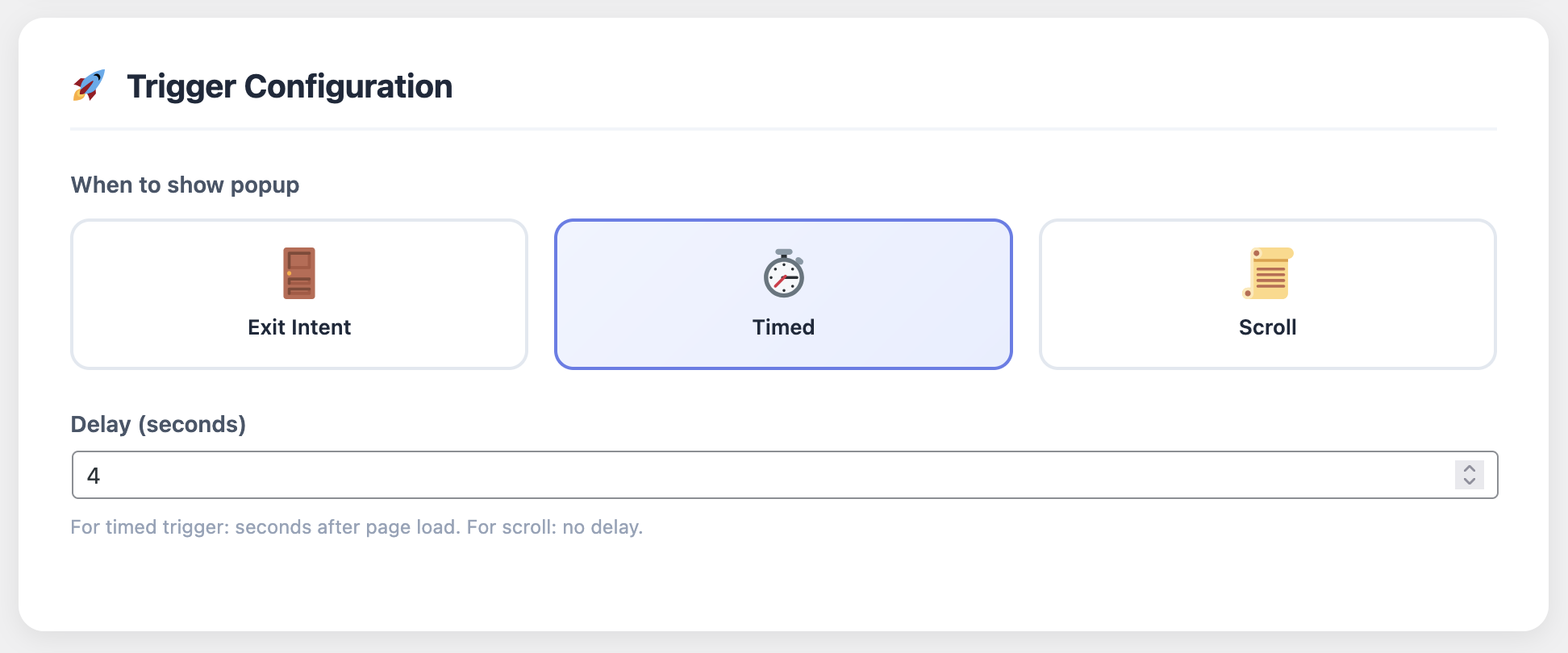
Trigger Settings for Popups - Configure when and how popups appear

Free vs. Pro: What’s the Difference?

Cart Recovery Pro actually offers a free version if you want to test the waters first. Smart move, honestly—try before you buy. The free version gives you a taste of what’s possible and lets you see real results before investing in the full platform.

The free version includes:

  • Basic cart tracking (real-time monitoring of abandoned carts)
  • Up to 3 automated email sequences (enough to test the concept)
  • Simple exit-intent popup (basic design templates)
  • Basic analytics (recovery rates and revenue recovered)
  • Email support (community forum access)

The Pro version unlocks:

  • Unlimited email sequences (create as many campaigns as you need)
  • SMS and WhatsApp integration (multi-channel recovery)
  • Web push notifications (reach customers even when they’re not browsing)
  • Advanced popups and spin-to-win wheels (gamification and higher conversion rates)
  • Dynamic coupon generation (automatic discount code creation)
  • A/B testing for emails and popups (optimize what works)
  • Detailed analytics and revenue tracking (comprehensive reporting)
  • Customer journey tracking (see the full path before abandonment)
  • Advanced segmentation (target campaigns based on cart value, products, customer history)
  • Priority support (fast response times and dedicated help)
  • GDPR compliance tools (consent management, data retention controls)

My recommendation? Start with the free version to get a feel for it. Once you see the results, upgrade to Pro. The ROI is usually immediate—like, first-week immediate. Most stores see enough recovered revenue in the first month to justify the Pro upgrade several times over.

Advanced Strategies That’ll Put You Ahead of the Competition

Okay, now that you know the basics, let’s talk about some ninja-level tactics that’ll maximize your recovery rate. These strategies separate the stores recovering 15% from those recovering 30%+:

Segment Your Recovery Campaigns

Not all abandoned carts are created equal. A cart with a $500 item deserves different treatment than a cart with a $20 item. Set up different email sequences based on cart value, product category, customer history, and behavior patterns.

  • High-value carts ($200+): More personalized emails, maybe even a phone call follow-up. Use SMS for immediate attention. Offer larger discounts or free expedited shipping. Consider a dedicated account manager approach for VIP customers.
  • Medium carts ($50-$200): Standard 3-email sequence with a discount in the final email. Focus on product benefits and social proof. Include customer reviews and testimonials.
  • Low-value carts ($0-$50): Shorter sequence, focus on urgency rather than discounts. Maybe just 2 emails—one reminder, one final offer. Keep it simple and direct.
  • Repeat customers: Different messaging that acknowledges their loyalty. “We noticed you’re back—here’s an exclusive offer for returning customers.”
  • First-time visitors: Welcome messaging with a special first-purchase discount. Focus on building trust and addressing common concerns.

Advanced segmentation can also include product categories (electronics vs. clothing), geographic location (different shipping offers), device type (mobile vs. desktop), and traffic source (organic vs. paid ads). The more targeted your campaigns, the higher your conversion rates.

Use Dynamic Content

Show exactly what they left behind. Product images, names, prices—all dynamically inserted into your emails. This isn’t just professional-looking; it increases conversion rates by 20-30% compared to generic “you forgot something” emails.

Dynamic content goes beyond just product information. Include:

  • Personalized product recommendations based on what they abandoned
  • Related products they might also like
  • Customer reviews for the specific products in their cart
  • Stock levels and availability (create urgency)
  • Recently viewed products (remind them of other items they considered)

The more relevant and personalized your content, the more likely customers are to return and complete their purchase.

Test, Test, Test

The email timing I mentioned earlier (1 hour, 24 hours, 48 hours) works great for me. But your audience might be different. Test different timings. Test different subject lines. Test discount amounts. Test email designs. Cart Recovery Pro makes A/B testing stupid easy.

Here’s what to test:

  • Subject lines: Question-based vs. benefit-based vs. urgency-based
  • Send times: Morning vs. afternoon vs. evening. Weekdays vs. weekends
  • Discount amounts: 5% vs. 10% vs. 15% vs. free shipping
  • Email design: Image-heavy vs. text-focused vs. minimal
  • Call-to-action: Button text, color, placement
  • Personalization: First name vs. no name vs. product-focused

Run tests for at least 2-4 weeks to get statistically significant results. Then double down on what works and eliminate what doesn’t.

Leverage Social Proof and Urgency

People are more likely to buy when they see others buying and when they feel a sense of urgency. Incorporate both into your recovery campaigns:

  • Social proof: “Join 10,000+ happy customers” or “X people bought this today” or “Rated 4.8/5 stars by customers”
  • Urgency: “Your cart expires in 48 hours” or “Limited stock available” or “Offer ends soon”
  • Scarcity: “Only 3 left in stock” or “Last chance to get 15% off”

These psychological triggers can significantly increase conversion rates when used authentically and ethically.

For more advanced strategies, check out our comprehensive guide on how to reduce cart abandonment in WooCommerce: 7 proven strategies. It covers everything from checkout optimization to post-purchase follow-up.

Common Mistakes to Avoid

Before we wrap up, let me save you from some rookie mistakes I see all the time. These errors can kill your recovery rates and damage your brand reputation:

❌ Sending too many emails: Three is perfect. More than that and you’re just annoying people. Respect their inbox, or they’ll unsubscribe or mark you as spam.

❌ Offering discounts too quickly: Your first email shouldn’t include a discount. See if they’ll convert without it first. You’re training customers to wait for discounts if you offer them immediately.

❌ Boring subject lines: “Complete your order” is weak. Try “Is everything okay?” or “Quick question about your order” or “You left something behind—here’s why you’ll love it.” Personal, curious, and benefit-focused subject lines get opened.

❌ Ignoring mobile: 60%+ of cart abandonments happen on mobile. Make sure your emails and popups look great on phones. Test on multiple devices and email clients. Mobile optimization isn’t optional.

❌ Not following up on completed recoveries: Someone who just recovered a cart is prime for future marketing. Tag them, nurture them, and turn them into repeat customers. The recovery is just the beginning.

❌ Generic messaging: “You forgot something in your cart” is boring. Personalize based on what they abandoned, their purchase history, and their behavior. Make it feel like a human wrote it, not a robot.

❌ Ignoring data: Set it and forget it doesn’t work. Review your analytics regularly, identify trends, and optimize based on what the data tells you. What works today might not work tomorrow.

❌ Not testing: Assuming your first attempt is optimal is a mistake. Always be testing. Small improvements compound over time and can significantly increase your recovery rate.

Avoid these mistakes, and you’ll be ahead of 90% of stores. Most people set up basic recovery and never optimize. Be the exception.

The Psychology Behind Cart Abandonment

Understanding why people abandon carts isn’t just about statistics—it’s about psychology. When you understand the mental processes behind abandonment, you can create recovery campaigns that address the root causes, not just the symptoms.

Here are the key psychological factors at play:

  • Decision fatigue: Too many choices or a complicated checkout process overwhelms customers. Simplify your process and reduce friction.
  • Price sensitivity: Unexpected costs trigger loss aversion—people feel like they’re losing money. Be transparent about all costs upfront.
  • Trust issues: Security concerns, unfamiliar brands, or lack of social proof can cause abandonment. Address these directly in your recovery campaigns.
  • Distraction: Life happens. Customers get interrupted and forget. Your recovery emails remind them and make it easy to return.
  • Comparison shopping: Customers want to make sure they’re getting the best deal. Your recovery campaigns can highlight value, exclusivity, or time-sensitive offers.

For a deeper dive into the psychology of abandonment, check out our article on maximizing revenue with an abandoned cart plugin for WooCommerce. It covers behavioral psychology, conversion optimization, and advanced recovery tactics.

Stop Leaving Money on the Table

Join thousands of WooCommerce stores that are recovering 15-30% of abandoned carts on autopilot. Set up in 30 minutes, recover revenue forever.

Get Cart Recovery Pro →
Try Free Version First

The Bottom Line

Let’s be real for a second: cart abandonment is going to happen no matter what you do. It’s not a question of if, but how much. The difference between successful stores and struggling ones often comes down to this: what do you do about it?

You’ve already paid to get traffic to your site. You’ve already done the hard work of getting them interested enough to add items to their cart. Walking away without trying to recover those sales is literally throwing money in the garbage.

Cart recovery isn’t optional anymore—it’s essential. And with tools like Cart Recovery Pro, there’s no excuse not to have it set up. The time investment is minimal, the technical barrier is zero, and the ROI is frankly insane.

In 2026, the stores that win are the ones that maximize every opportunity. They don’t just drive traffic—they convert it. They don’t just acquire customers—they retain them. And they don’t just accept cart abandonment—they recover it.

For a complete guide covering everything from setup to advanced optimization, check out the complete guide to WooCommerce abandoned cart recovery 2025. It’s the most comprehensive resource available, with step-by-step instructions, real case studies, and proven strategies.

Ready to Stop Losing Sales?

Every day you don’t have cart recovery running is another day of lost revenue. Seriously—do the math. If you’re doing even $10K/month in sales, you’re probably losing $7K/month to cart abandonment. Recovering even 20% of that is $1,400 in found money. Every single month.

Don’t overthink this. Just get started. The free version lets you test everything risk-free. Once you see the results, upgrading to Pro is a no-brainer.

Start Recovering Abandoned Carts Today

Join 5,000+ WooCommerce stores recovering $12M+ in lost revenue annually. Set up in 30 minutes, recover revenue forever.

Get Cart Recovery Pro Now →
Download Free Version (€0)

P.S. – Still on the fence? Download the free version and see the results for yourself. You’ve got nothing to lose except… well, all those abandoned carts.

Frequently Asked Questions

How long does it take to set up cart recovery?

Most stores can get basic cart recovery up and running in 30 minutes or less. The initial setup involves installing the plugin, configuring email templates (or using pre-built ones), and setting your automation triggers. Advanced features like multi-channel campaigns and segmentation take a bit longer, but you can start simple and add complexity over time. The key is to get something running quickly, then optimize based on results.

What’s a good cart recovery rate to aim for?

Industry averages range from 10-15% for basic email-only campaigns, but stores using advanced multi-channel strategies typically see 20-30% recovery rates. Some high-performing stores achieve 35%+ with sophisticated segmentation and personalization. Your recovery rate depends on factors like your industry, average cart value, customer demographics, and the quality of your recovery campaigns. Start with industry benchmarks, then work to exceed them through testing and optimization.

Do I need technical skills to use a cart recovery plugin?

No technical skills required. Modern cart recovery plugins are designed for non-technical users with intuitive interfaces, drag-and-drop builders, and pre-built templates. If you can use WordPress, you can set up cart recovery. The most technical part is usually connecting your email service provider (which is typically just entering API credentials), and most plugins provide step-by-step guides for this. Advanced features like custom HTML email templates are optional and only needed if you want complete design control.

Will cart recovery emails annoy my customers?

When done correctly, cart recovery emails are helpful, not annoying. The key is to provide value—remind them what they left behind, offer assistance, and provide incentives that feel genuine. Most customers appreciate the reminder, especially if they genuinely forgot about their cart. Best practices include: limiting emails to 2-3 in a sequence, spacing them appropriately (not sending multiple emails in one day), providing clear unsubscribe options, and making sure your emails are mobile-friendly and well-designed. If customers find them annoying, they’ll unsubscribe, which is their right. But most stores find that well-crafted recovery emails actually improve customer satisfaction by making it easy to complete purchases.

Can I use cart recovery with other marketing tools?

Yes, most cart recovery plugins integrate with popular email marketing platforms (Mailchimp, Klaviyo, SendGrid, etc.), CRMs (HubSpot, Salesforce), analytics tools (Google Analytics), and e-commerce platforms. Integration allows you to sync customer data, trigger other marketing campaigns, and get a unified view of your customer journey. Check the plugin’s integration list to ensure it works with your existing marketing stack. Some plugins also offer webhook support for custom integrations with any tool that accepts webhooks.

How do I know if cart recovery is working?

Your cart recovery plugin’s analytics dashboard will show you key metrics: total abandoned carts, recovery rate (percentage of abandoned carts that convert), revenue recovered, ROI, and performance by channel (email, SMS, etc.). You should also see which emails perform best, what times of day convert highest, and which customer segments respond best. Track these metrics weekly at first, then monthly once you’ve optimized. A good sign that it’s working: you see recovered revenue that you wouldn’t have had otherwise. Compare your recovery rate to industry benchmarks and your own historical performance.

Is cart recovery GDPR compliant?

It depends on the plugin and how you use it. Reputable cart recovery plugins include GDPR compliance features like consent management, data retention controls, and the ability to handle data deletion requests. However, compliance also depends on your implementation: you need to get proper consent before collecting email addresses, provide clear privacy policies, and honor opt-out requests. Look for plugins that explicitly mention GDPR compliance and provide tools to manage consent. When in doubt, consult with a legal professional familiar with privacy regulations in your jurisdiction.

What’s the difference between free and paid cart recovery plugins?

Free plugins typically offer basic features: simple email sequences (usually limited to 1-3 emails), basic cart tracking, and simple analytics. Paid plugins unlock advanced features: unlimited email sequences, multi-channel support (SMS, WhatsApp, push notifications), advanced segmentation, A/B testing, dynamic coupon generation, detailed analytics, priority support, and more customization options. Free plugins are great for testing the concept, but paid plugins provide the features needed to maximize recovery rates and ROI. Most stores find that the additional revenue recovered more than justifies the cost of a paid plugin.

Have more questions? Check out our comprehensive resources on WooCommerce abandoned cart recovery, or reach out to our support team for personalized assistance.