

Let’s talk about a problem every WordPress team faces: communication chaos. You’ve got Slack messages getting buried, emails going to spam, Post-its scattered across desks, and important information living in fifteen different places. Sound familiar?
Then someone asks “Did anyone update that plugin?” and you get the dreaded “I thought YOU were going to do that” response. Communication breakdown. Project derailment. Frustration all around.
Here’s a radical idea: what if your team communicated where they actually work? Not in another app, not in email—right there in the WordPress dashboard where everyone spends their time. In this guide, I’ll show you how dashboard notes can transform your team communication from scattered to streamlined.
Why Traditional Team Communication Fails
Before we dive into solutions, let’s diagnose the problem. Why does team communication around WordPress projects always seem so… messy?
The Context-Switching Problem
💡 The Reality: Every time someone has to leave WordPress to check Slack/email/project management software for task details, they lose 5-10 minutes. Not just the time to switch apps—the time to refocus and remember what they were doing. It’s called context switching, and it’s a productivity killer.
Picture this workflow:
- You’re editing a post in WordPress
- You think “wait, what was the SEO guideline for this?”
- Leave WordPress
- Check Slack (get distracted by three other conversations)
- Search for the guideline (can’t find it)
- Check email (get distracted again)
- Finally find it in a Google Doc somewhere
- Return to WordPress having forgotten what you were doing
Total time wasted: 15-20 minutes. And this happens multiple times per day.

The “Who Needs to Know” Problem
Broadcast messages in Slack? Everyone ignores them because most people don’t need that info. Targeted DMs? You spend half your day just figuring out who needs to know what. Email? LOL, good luck with that.
The problem is lack of smart targeting. You need a system that automatically shows the right information to the right people.
Dashboard Notes: Your Team Communication Hub
Here’s where Dashboard Quick Notes becomes a game-changer for team communication. It’s not just a notes plugin—it’s a targeted communication system.
Role-Based Communication
Remember that “who needs to know” problem? Dashboard Quick Notes solves it elegantly with role-based visibility:
- Editors see editorial guidelines and content deadlines
- Authors see style guides and submission info
- Administrators see technical updates and security alerts
- Shop Managers see inventory and order notifications
- Custom roles see whatever makes sense for their workflow
⚡ Real-World Example: You need to communicate a plugin update. Instead of sending a message that 90% of your team ignores, create a note visible ONLY to administrators. The people who can act on it see it. Nobody else is bothered. That’s smart communication.
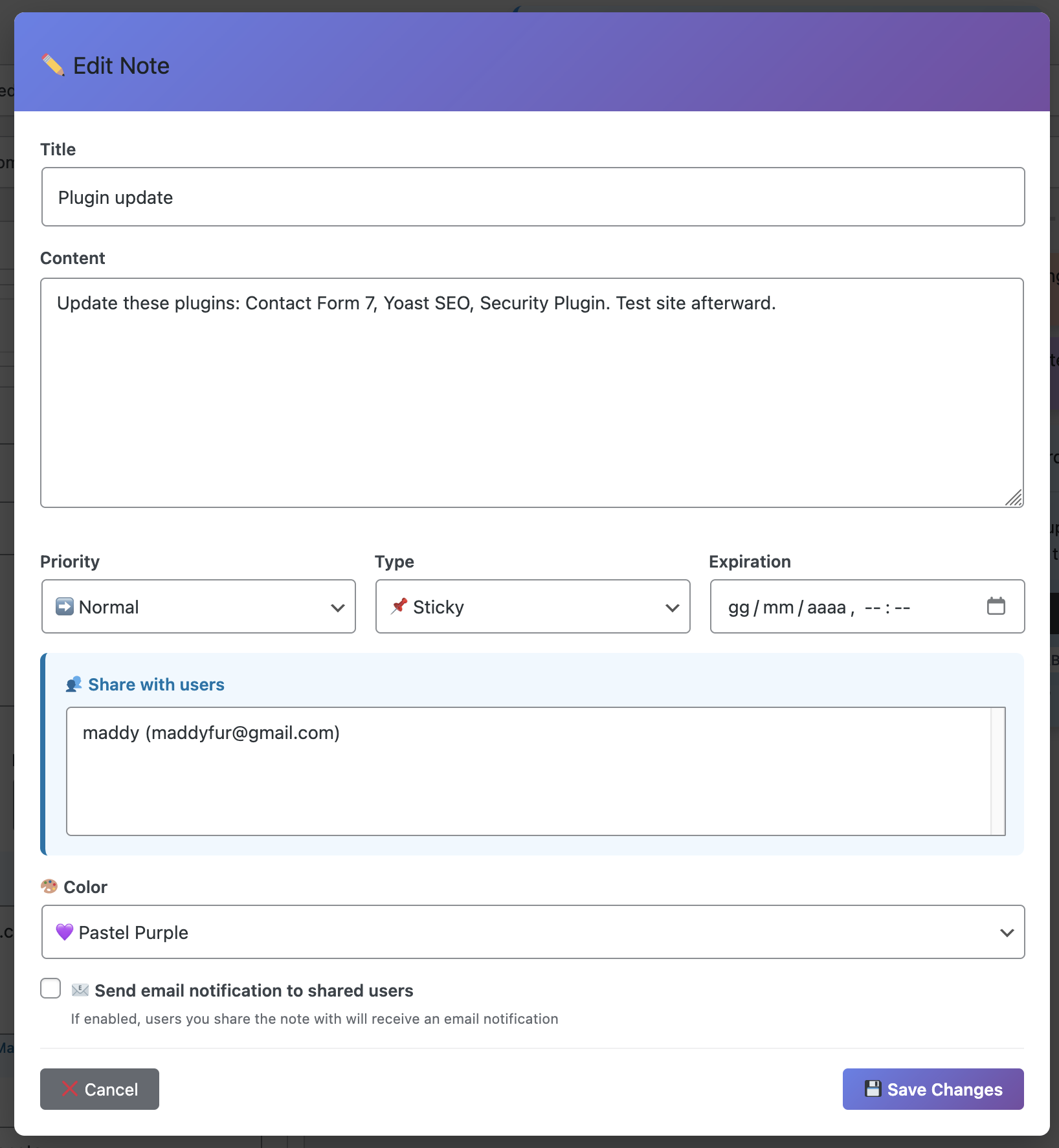
Context-Aware Messaging
Dashboard Quick Notes also supports page-specific visibility. This means:
Content guidelines appear ONLY on the post editor
Why it works: Authors see reminders exactly when they need them, not randomly throughout the day
Plugin warnings appear ONLY on the plugins page
Why it works: Admins see technical info when they’re in tech mode, not when they’re writing content
Result: Communication that respects context and attention. Messages land when they’re relevant, not as background noise.
Team Communication Use Cases
Let me show you real scenarios where dashboard notes transform team communication:
Scenario 1: The Content Team
The Old Way: Email chain with 47 replies about editorial guidelines. Half the team never sees it, the other half ignores it.
The Dashboard Notes Way: Create a note visible to Editors and Authors, displayed on post editing screens. Guidelines are right there when people are writing. No searching, no email chains, no “I didn’t see that.”
📝 Example Note: “Blog Post Guidelines: Min 800 words, include 2-3 images, use H2/H3 headers for SEO, target keyword in first paragraph. Questions? Ping @editor-name.”
Result: Content quality improves because reminders are contextual, not buried in old emails.
Scenario 2: The Development Team
The Old Way: Developer makes a critical change, mentions it in Slack, half the team doesn’t see it because they weren’t online.
The Dashboard Notes Way: Create an urgent (red) note visible to Administrators and Developers: “IMPORTANT: New staging environment URL – test there before production. Old staging disabled.”
Result: Nobody accidentally pushes to the wrong environment because the warning is unmissable right in their workflow.

Scenario 3: The E-commerce Team
The Old Way: Shop manager sends email about inventory issues. Customer support team doesn’t see it. Customers complain about out-of-stock items still being advertised.
The Dashboard Notes Way: Note visible to Shop Managers AND Customer Support, displayed on WooCommerce pages: “Low stock alert: Product X – estimated restock Friday. Update customers accordingly.”
Result:Everyone who needs to know sees the same info, customer service improves dramatically.
Scenario 4: The Agency Handoff
The Old Way: Project manager leaves, new PM has no idea what’s happening. Cue panic and desperate Slack DMs to the old PM.
The Dashboard Notes Way: All project context lives in dashboard notes. New PM logs in and immediately sees priorities, ongoing issues, client preferences, technical gotchas—everything documented right there.
Result: Smooth transitions, preserved institutional knowledge, no more “why did we do it that way?” confusion.
Setting Up Team Communication Guidelines
For dashboard notes to work as a team communication tool, everyone needs to be on the same page about how to use them. Here’s how to set up your team for success:
Establish Note Conventions
Create a shared understanding of what different note types mean:
🔴 Red Notes: Urgent action required now (site issues, deadline today, client emergency)
🟠 Orange Notes: Important tasks this week (project deliverables, maintenance)
🟡 Yellow Notes:Reminders and non-urgent tasks
🔵 Blue Notes: FYI information and resources
🟢 Green Notes: Positive updates and completed items
Document this system and make sure everyone understands it. Create a permanent blue note explaining the color coding!
Define Note Ownership
Decide who can create what kinds of notes:
- Administrators: Can create any note for any role
- Editors: Can create notes for content team
- Team Leads: Can create notes for their department
- Regular Users:Maybe read-only, or can suggest notes for approval
⚡ Pro Tip: Assign a “Note Coordinator” (part-time role, 15 min/day) who reviews and archives completed notes, ensures important messages are properly tagged, and maintains the system. Without someone owning this, systems drift into chaos.
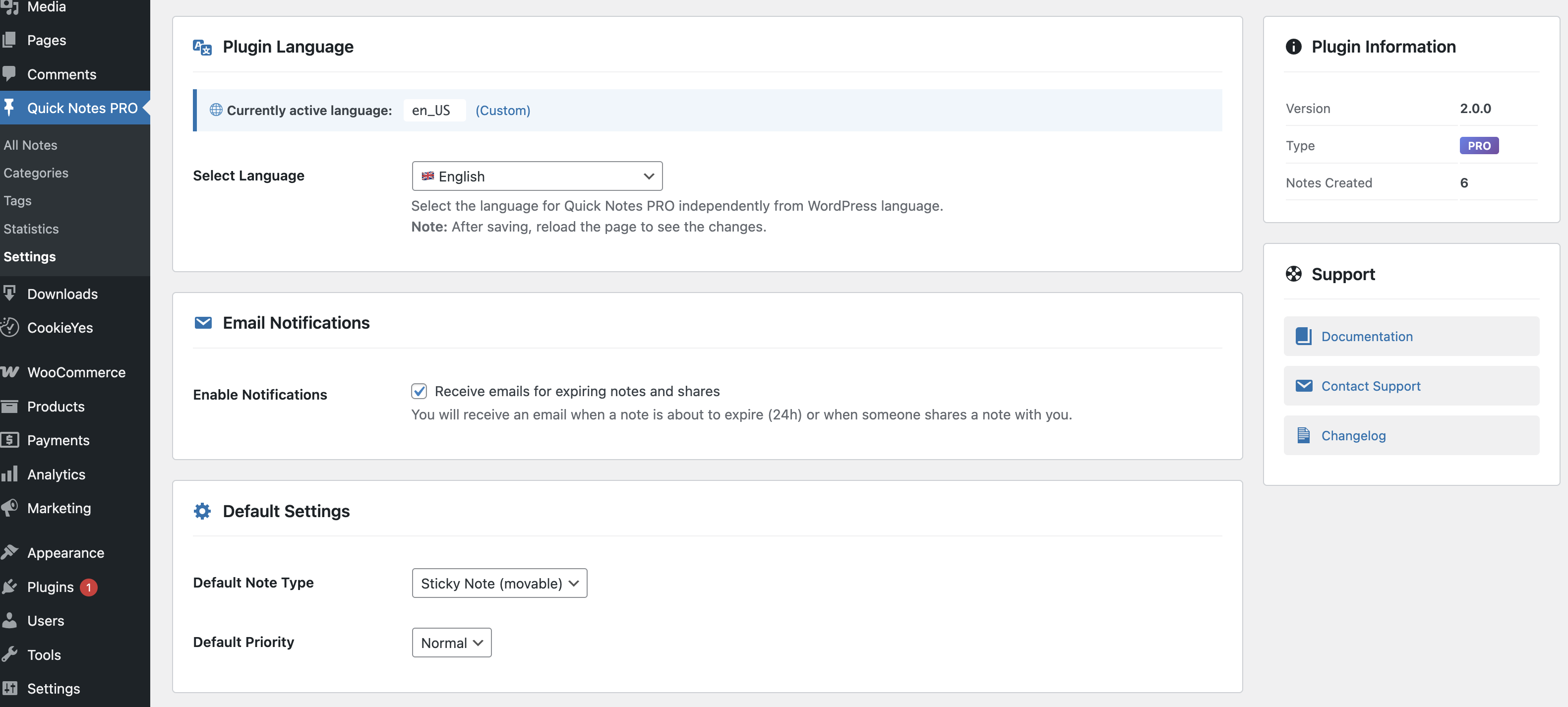
Advanced Team Communication Strategies
Once your team is comfortable with basic dashboard notes, level up with these advanced techniques:
The Daily Standup Note
Instead of Slack-based standups, create a daily note where team members add their status:
Daily Standup – Monday Oct 21
📝 John: Finishing homepage redesign, ETA 3pm
🎨 Sarah: Working on blog images, need feedback by EOD
⚙️ Mike: Plugin updates complete, tested on staging
📊 Lisa: Analytics report ready, link in resources
Everyone sees team status without meetings. Archive at day’s end, create fresh note tomorrow.
The “Blocked” System
Create an orange note for blocked tasks. Anyone who’s stuck adds their blocker:
- “Can’t proceed with design – waiting for logo from client”
- “Need admin access to staging environment”
- “Stuck on plugin conflict – need dev help”
Problems become visible immediately instead of festering in silence. Team leads can unblock people proactively.
The Knowledge Base Note
Permanent blue notes for frequently-needed info:
- “Where to find…” directory (staging URLs, documentation, assets)
- “How to…” quick guides (deploy process, backup procedure)
- “Who to ask…” contact list (who handles what on the team)
Position these at the bottom of the dashboard. They’re not urgent, but always accessible.

Measuring Communication Improvement
How do you know if dashboard notes are actually improving team communication? Look for these indicators:
- Fewer “I didn’t know” excuses (info is unavoidable in dashboard)
- Reduced Slack/email volume for routine updates
- Faster task completion (no time wasted hunting for info)
- Better knowledge retention when team members change
- Fewer repeated questions (answers are documented and visible)
- Less context switching (info lives where work happens)
💡 Real Data: Teams using Dashboard Quick Notes report 30-40% reduction in routine communication overhead. That’s hours per week reclaimed for actual work.
Common Team Communication Pitfalls
Don’t make these mistakes that sabotage dashboard note systems:
❌ Note Overload
Creating 50 notes on day one. Start with 5-10 key messages, add gradually. Too many notes = ignored notes.
❌ Wrong Visibility Settings
Showing technical notes to content team, or vice versa. Target appropriately or face banner blindness.
❌ No Maintenance
Never archiving, updating, or cleaning up notes. Stale info is worse than no info.
❌ Duplicating Other Channels
Posting the exact same message in Slack, email, AND dashboard notes. Pick one primary channel (hint: make it dashboard notes).
The Bottom Line
Here’s the truth: your team is already communicating. The question is whether that communication is scattered across a dozen tools, or centralized where work actually happens.
Dashboard Quick Notes transforms your WordPress dashboard into a smart communication hub that respects roles, context, and attention.
Ready to Streamline Team Communication?
Stop juggling communication tools. Bring team messaging where work happens.
Your team will thank you. Your productivity metrics will thank you.Your sanity will definitely thank you.
Now go bring your team communication out of chaos and into clarity! 🎯